
OpenFront · Economy · Guide
OpenFront Money Guide — Gold, Cities, Ports and Factories
An OpenFront money guide covering gold income, the full price ladder, city, port and factory payback, trade ships, piracy and when to stop saving.
By the New Game Wiki team · Updated 2026-10-04
On this page (11)
- Where Gold Comes From
- The Full Gold Price Ladder
- Cities, Ports and Factories as Engines
- Reinvest or Hoard
- Trade, Piracy and Donations
- Reading Your Income
- How do you make money in OpenFront?
- Should I build ports or factories in OpenFront?
- What is the most expensive building in OpenFront?
- How much does the first city cost in OpenFront?
- Can other players steal my gold in OpenFront?
An OpenFront money guide has to answer one question first: where does gold actually come from? There are three sources, and they scale very differently. Passive income ticks up every second whether you do anything or not. Conquest pays lump sums for finished opponents. Trade, through ports and factories, produces the compounding income that decides long games. Understanding which one you are leaning on is the difference between a strong opening and a strong position.
Where Gold Comes From
The community wiki describes passive income as a flat rate of 100 gold per tick for human players, roughly 1,000 gold per second, while bots receive 50 per tick. Additional gold arrives from conquering players, bots and nations, from donations between allies, and from trading. The official client puts the same idea in the leaderboard, breaking income into gold per minute, ship trade, train trade and piracy, so you can see which of the three sources is actually carrying you. A cash reserve with a flat income line is a warning sign, not a safety net.
| Source | How it pays | How it scales |
|---|---|---|
| Passive income | A flat rate every tick, reported as 100 per tick for humans | Never; it is the floor, not the plan |
| Conquest | A lump sum when you finish a player, bot or nation | With the number of opponents you can close out |
| Trade | Ships and trains pay both ends of a route | With route length and structure count |
| Donations | Allies can send gold directly | With diplomacy, not economy |
| Piracy | Captured trade ships switch their income to you | With enemy route value, and only while it lasts |
The Full Gold Price Ladder
Prices in OpenFront scale with how many of a structure you already own, and a few pairs share a single ladder. The community wiki records the following costs, which the current community wiki confirms with minor rounding differences:
| Purchase | Cost formula | Cap |
|---|---|---|
| City | 125,000 x 2 to the city count | 1,000,000 |
| Port | 125,000 x 2 to the port count | 1,000,000 |
| Factory | 125,000 x 2 to the factory count | 1,000,000 |
| Warship | 250,000 x (warship count + 1) | 1,000,000 |
| Defense Post | 50,000 x (post count + 1) | 250,000 |
| SAM Launcher | 1,500,000 then 3,000,000 | 3,000,000 |
| Missile Silo | 1,000,000 flat | 1,000,000 |
| Atom Bomb | 750,000 flat | 750,000 |
| Hydrogen Bomb | 5,000,000 flat | 5,000,000 |
| MIRV | 25,000,000 plus 15,000,000 per earlier MIRV | Rising |
Ports and factories share one ladder, so your first port costs 125,000 but the next factory will already cost 250,000, and vice versa. That is why most guides advise picking one to lean on early rather than splitting your spend.
Cities, Ports and Factories as Engines
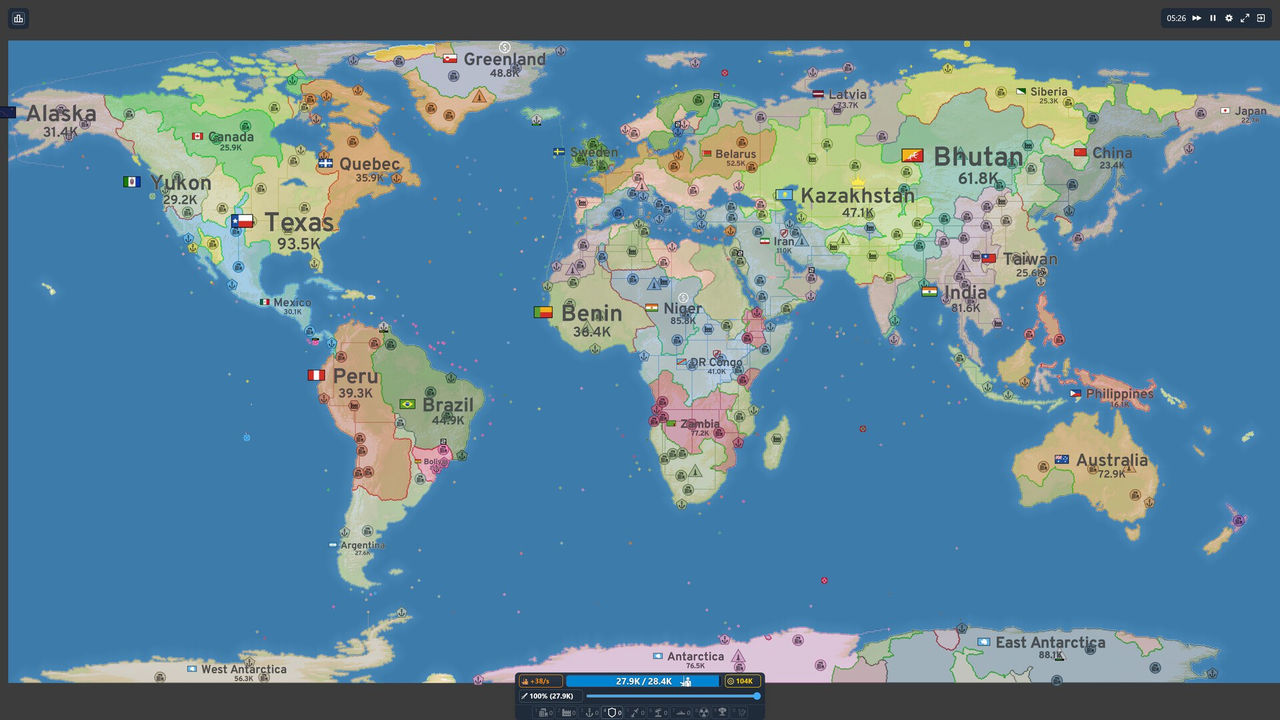
Cities are not income buildings, but they are the best indirect investment in the game because maximum population is what your army grows into. Each city raises max population, and the community figure for that increase has shifted between patches, so treat exact per-city numbers as version-sensitive. Ports and factories are the direct income engines: a port sends a trade ship toward another port and pays both owners, with longer routes paying more, while a factory connects nearby cities and ports by rail and spawns trains that pay each station they visit. You can also earn from other players' trains and trade ships if their routes pass through your structures, which rewards placing your infrastructure on busy lines.
Reinvest or Hoard
The beginner walkthrough is unusually direct about this: do not sit on hundreds of thousands or millions of gold waiting for a perfect moment, because idle gold makes you weaker. The pattern that works is alternating purchases so you always have the next structure already paid for.
- Early: buy cities aggressively, adding one port or factory to keep income moving.
- Mid: keep expanding the cheaper end of the economy ladder instead of chasing an expensive tier.
- Late: hold a deliberate reserve only when you are closing on a silo, a SAM or a bomb.
- Always: match every missile silo with SAM coverage before you provoke a nuclear exchange.
Trade, Piracy and Donations
Trade is not automatically safe. Ports send trade ships on routes that pass other players, and an enemy warship can capture them, redirecting the income. The beginner guide frames a warship as a 250,000-gold entry ticket to piracy, which is cheap when your rival is running a long, rich route. Alliances matter here because an ally's warships will not capture your trade ships. Attacking or being attacked pauses trade with that player for five minutes or until you become allies again, so a war you did not plan can quietly cut your income as well as your army.
Reading Your Income
- Gold per minute: your passive baseline; it should never be your only number.
- Ship trade: the port economy; grows with route length and port count.
- Train trade: the factory economy; grows with station count, not just factory count.
- Piracy: captured trade; high early for a raider, unreliable once rivals screen their routes.
- Cash on hand: useful only when it is about to become a structure.
FAQ
How do you make money in OpenFront?
Gold comes from three places. Every player generates a flat passive income, believed to be 100 gold per tick for humans and 50 per tick for bots on the community wiki; conquering players, bots and nations pays a lump sum; and trade through ports and factories produces ongoing income. In practice the third source is what separates a mid-game leader from a late-game winner, because passive income alone cannot fund cities, silos and SAMs at the same time.
Should I build ports or factories in OpenFront?
Ports if you have a coastline, factories if you do not. Ports spawn trade ships that sail to other players' ports and earn gold for both sides, and they are required before you can build warships. Factories do the same job inland by connecting cities and neighbouring structures with rail and spawning trains. The two share a single price ladder, so your third port-or-factory costs 500,000 whichever you pick.
What is the most expensive building in OpenFront?
The MIRV is the most expensive purchasable weapon. The community wiki lists the first MIRV at 25,000,000 gold and notes the price rises with every MIRV already launched, and the current community wiki quantifies that rise as 15,000,000 per earlier launch. Hydrogen bombs are the next tier at 5,000,000, and atom bombs sit at 750,000, all of them requiring a missile silo first.
How much does the first city cost in OpenFront?
The first city costs 125,000 gold, the second 250,000, the third 500,000, and every city after that 1,000,000. Cities raise maximum population, which is the same ladder that limits your army, so they are usually the first economic purchase. Ports, factories and cities all follow the 125,000 / 250,000 / 500,000 / 1,000,000 progression.
Can other players steal my gold in OpenFront?
They can intercept the income, not the bank. Ports send trade ships that sail to other ports; if an enemy warship captures one of your trade ships, that trade is diverted to them. The beginner guide puts the entry price for piracy at 250,000 gold for a warship, and the official help notes that attacking or being attacked pauses trade with that player for five minutes or until you become allies again.
References
- Gold - OpenFront.io Wiki - Miraheze
- Buildings
- OpenFront Beginner Guide (2026) | How to Win Your First Games — YouTube
- The Ultimate OpenFront.io Factory Guide — YouTube
- OpenFront on Steam
Facts on this page are compiled from the references above. Items marked "to confirm" are single-source and not yet verified.