
Nuclear Design Bureau · Devices · Guide
Nuclear Design Bureau RDS-1 — The Directive Device and How to Build It
Nuclear Design Bureau RDS-1 in the game: a named campaign directive device, the material constraints around it, and how to approach a first build.
By the New Game Wiki team · Updated 2026-10-04
On this page (8)
- RDS-1 as a Campaign Directive
- How the Game Expects a First Device to Be Built
- Keeping the Scope In-Game
- What is RDS-1 in Nuclear Design Bureau?
- Does the game simulate the real RDS-1 device?
- What does a directive give you before you build?
- How do I check a design before running the detonation?
- What happens if the directive device fizzles?
In Nuclear Design Bureau, RDS-1 is the name attached to a campaign directive device rather than a standalone mode. The campaign is a series of numbered directives, and community material titles one of them Directive 3-1 RDS-1, with the follow-up appearing in a Steam discussion thread as RDS-4 Directive 3-2. This page covers the in-game directive only: what the game asks of you, how it expects a device to be assembled, and how to check your work before the red button.
RDS-1 as a Campaign Directive
The directive system is the campaign's spine. You play a junior engineer at the Kurchatov Institute, the State gives you a target, and you build a device that meets it. Some directives limit which materials you may use on that job, which turns each one into a constrained puzzle rather than an open sandbox problem.
| Directive element | Documented behaviour |
|---|---|
| Goal | A technical requirement handed down from the State |
| Constraints | Material limits apply on some directives |
| Naming | Directives are numbered and carry device names such as RDS-1 and RDS-4 |
| Follow-on directives | Campaign expansion, many more directives and a voiced campaign are on the roadmap |
| Success condition | The device does what the directive asks, evaluated by the simulation |
- Read the brief before touching the blueprint grid, because a material limit discovered late invalidates a design.
- Expect the campaign to be the constrained track and sandbox mode to be the free one.
- Treat each directive as a diagnosis exercise: the brief tells you what to achieve, not how.
- Check the community hub for directive-specific threads, since RDS-series naming makes them easy to search.
How the Game Expects a First Device to Be Built
The official description splits a device into a primary, a casing and the supporting systems, and it puts the criticality lab before the design phase rather than after. That ordering is deliberate: you are expected to understand how close your materials are to criticality before you commit to a layout on the grid.
| Build stage | What the game provides |
|---|---|
| Measure | The criticality lab: core in its cradle, beryllium reflector, live k-effective estimate |
| Design | Materials painted straight onto the blueprint grid |
| Assemble | Primary, casing and supporting systems |
| Simulate | Full detonation physics run in real time from the red button |
| Refine | Diagnosis and rebuild after a fizzle, failure or waste of material |
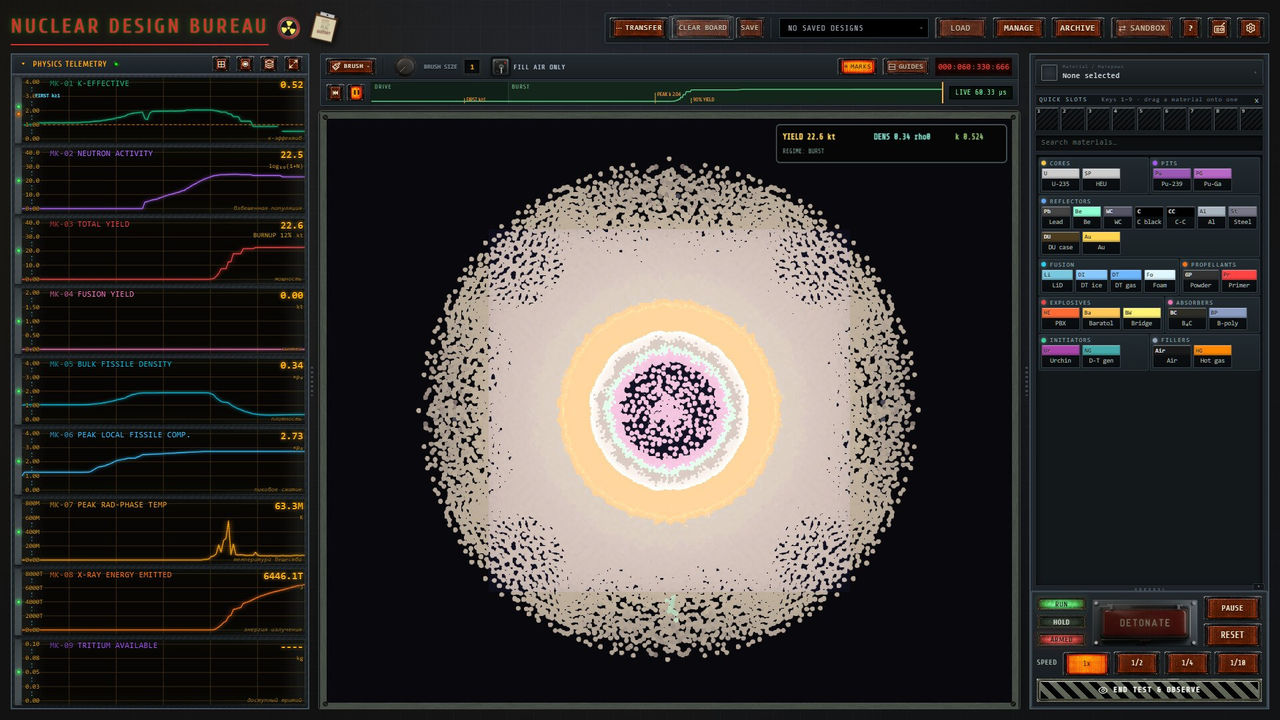
Practical habits that follow from that structure:
- Start in sandbox mode if you want to learn the physics without a material limit, then return to the directive.
- Save the design as you go, because the game keeps designs in a design files box rather than saving every experiment automatically.
- Keep the first device simple, since the simulation is compute-heavy and the store warns that large designs run slowly on minimum hardware.
- Expect yields to move between patches: an official physics patch changed how fissile material resists compression and explicitly noted that yields will change.
Keeping the Scope In-Game
Because this game is set around a design bureau and uses device names that echo real programmes, it is easy to blur the line between the simulation and the historical record. Do not. What the game models is a physics-driven sandbox: shockwaves, heat, radiation and chain-reaction behaviour in real time, with a criticality lab built around a Monte Carlo estimate and an operator who absorbs exposure. Real-world history, real devices and real programme timelines are not part of this simulation's documentation and are not treated as game facts here.
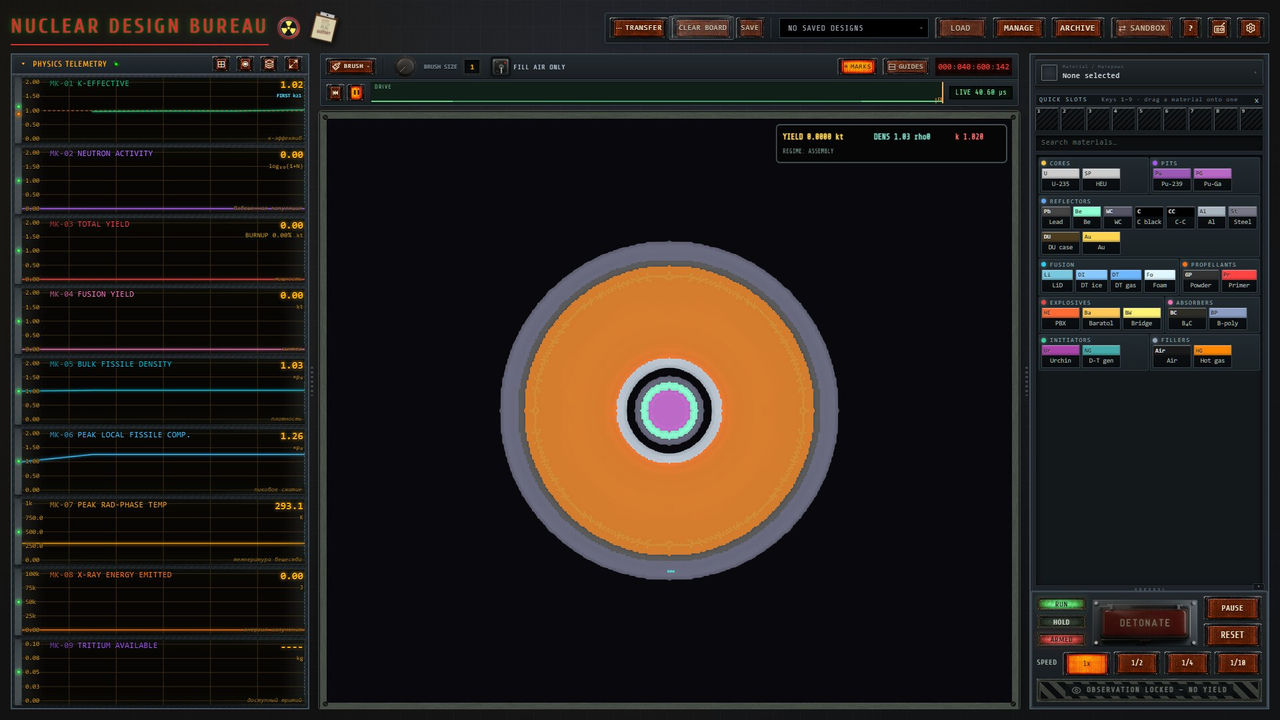
The in-game constraints are what matter for planning: material limits on some directives, limited grid resolution on weaker machines, and a physics model that the developer keeps adjusting. If your directive device will not ignite, the tips page collects the reported workarounds, the implosion page explains the compression step, and the guide page walks the whole loop in order.
FAQ
What is RDS-1 in Nuclear Design Bureau?
RDS-1 is the name attached to a campaign directive device in the game rather than a separate mode. Community material titles one of the directives Directive 3-1 RDS-1, and a Steam discussion thread for the follow-up reads Can't get RDS-4 Directive 3-2 to work, which confirms that directives are numbered and carry device names of this kind.
Does the game simulate the real RDS-1 device?
No. This page covers only the in-game directive and the mechanics the game uses for it. Historical information about any real device is outside the scope of a game guide, and mixing the two would misrepresent what the simulation actually models.
What does a directive give you before you build?
A target and constraints. The game gives you a technical requirement plus a warehouse of materials, and some directives limit which materials you are allowed to use, so the brief defines both the goal and the ceiling on your design freedom.
How do I check a design before running the detonation?
Use the criticality lab. It is a first-person room where you place the core in its cradle, lower the beryllium reflector and watch a live Monte Carlo k-effective estimate climb toward one on a wall counter that lags like a real instrument, with exposure showing on the operator.
What happens if the directive device fizzles?
You refine it. Refining is a named phase of the official loop: if a device fizzles, fails or wastes material, you work out why and change it. The current build is described as playable end to end, so a failed directive is meant to be diagnosed rather than abandoned.
More in Devices
More devices pages in Nuclear Design Bureau.
- Nuclear Design Bureau Implosion — Compression, Casing and CriticalityGuideUpdated 2026-10-04
References
- Nuclear Design Bureau on Steam
- Can't get RDS-4 Directive 3-2 to work — Steam discussion
- Nuclear Design Bureau — Steam Community Hub news and patch notes
- Nuclear Design Bureau — Directive 4-3 Snapdragon v1.0 (community video)
Facts on this page are compiled from the references above. Items marked "to confirm" are single-source and not yet verified.