
Hex Reverse · Mechanics · Guide
Hex Reverse Tips — Edges, SP, Gold and the Base Loop
Hex Reverse tips for the first runs: read the touching edge instead of the card total, spend SP early, and treat the base phase as where progress is kept.
By the New Game Wiki team · Updated 2026-10-08
On this page (10)
- Read the Touching Edge, Not the Card Total
- Spend SP Before You Think You Need To
- Treat the Base as the Real Progression
- Trade With a Goal in Mind
- Mistakes That Cost Runs
- What is the single most useful Hex Reverse tip for a beginner?
- When should you spend SP in Hex Reverse?
- Should you buy cards or fuse them first?
- How do you keep progress in Hex Reverse?
- What mistake wastes the most time in Hex Reverse?
The most useful Hex Reverse tips all come back to one idea: this game rewards reading the board, not collecting the biggest numbers. A card carries six values, one per side, and the only values that ever matter are the ones on edges that touch another card. From that single rule, a handful of practical habits follow for your first runs, and every one of them is grounded in what the Steam store description actually says rather than in guesswork.
Read the Touching Edge, Not the Card Total
New players look for the card with the highest total, and the store description quietly points the other way: choose your position carefully, read the board, and use each card's strengths to take control of as much territory as possible. A card with six middling values rarely loses an edge badly, while a card with one enormous side is a weapon only when that side faces the enemy. Before you commit a placement, count how many of your six edges will end up touching enemy cards.
Spend SP Before You Think You Need To
SP activates skills, and the store description lists what those skills can do: strengthen cards, change their element, weaken opponents, draw additional cards and alter the flow of battle. Because those effects can change an edge comparison that looks lost, SP is not a resource to hoard for a rainy day. The specific costs are not documented, so the working habit is to decide what the current battle needs before the board is more than half full.
Treat the Base as the Real Progression
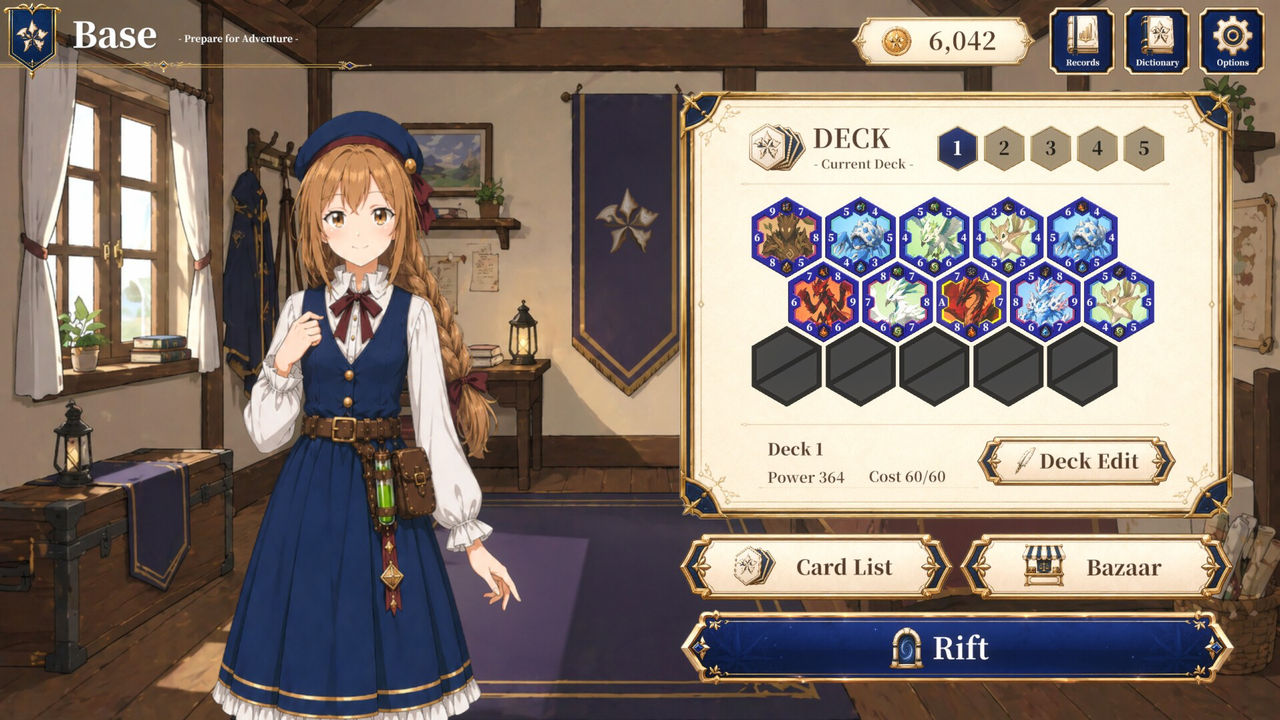
After a run ends you return to your base, and the base is where lasting progress happens. The description lists building and refining saved decks, buying and selling cards, fusing cards into stronger ones, and upgrading equipment that provides permanent progression. What a lost battle costs is not documented yet, so the safest mental model is that your collection, your saved decks and your equipment upgrades are the part you bank, while the run deck is the temporary layer.
| Layer | Permanence |
|---|---|
| Equipment upgrades | Described as permanent progression |
| Saved decks built at base | Persist outside the run |
| Cards bought, fused or pulled | Added to your collection |
| The run deck grown mid-expedition | Belongs to the current run |
Trade With a Goal in Mind
Three routes feed a collection, and they are easier to use once you pick a target. The Bazaar handles buying and selling for gold, fusion turns cards into stronger ones, and random packs add cards with a chance at an S-rank result. None of the prices, gold payouts or drop rates are published, so there is no spreadsheet to optimise; the practical tip is to decide what your current deck lacks and spend toward that instead of accumulating everything.
Mistakes That Cost Runs
- Stacking every card on one side of the 19-space board, which lets a single enemy flip cascade back through your territory.
- Ignoring SP for the first battles, then meeting later Rifts with cards that were never strengthened or re-elemented.
- Treating the post-battle card pick as a collection screen rather than a deck decision, since each pick changes the deck for the battles ahead.
- Expecting to reach the higher Rifts immediately, when the ladder is described as increasingly difficult and is meant to follow collection growth.
If you want the mechanical background behind these habits, the cards page explains the six-value card and the gameplay page covers the run loop, SP and the Rift ladder. The walkthrough page turns the same ideas into an ordered plan.
FAQ
What is the single most useful Hex Reverse tip for a beginner?
Stop reading a card as a total and start reading it as six separate numbers. Only the edge that touches an enemy card is ever compared, so a card with one huge side and five weak ones is a specialist, not a strong pick. The store description says to choose your position carefully, read the board and use each card's strengths, which is a polite way of saying placement beats raw power.
When should you spend SP in Hex Reverse?
Early and deliberately, rather than hoarding it. The store description says SP activates skills that can strengthen cards, change their element, weaken opponents, draw additional cards and alter the flow of battle, so a skill is often what turns a losing edge into a flip. A run that ignores SP for its first few battles will feel weaker than its card list suggests.
Should you buy cards or fuse them first?
Plan both around the same goal rather than treating them as separate shops. Buying at the Bazaar grows a collection, fusing turns cards into stronger ones, and random packs are the third route to new cards, with S-rank results reachable through fusion and through packs. Because gold income per run is not documented, it helps to decide what you are building toward before you spend.
How do you keep progress in Hex Reverse?
Treat the base phase as the real save file. Equipment upgrades are described as providing permanent progression, and the base is where you build and refine saved decks and fuse cards, so those changes outlive any single run. What a lost battle costs is not documented yet, so the safe assumption is that the permanent layer is what you actually keep.
What mistake wastes the most time in Hex Reverse?
Committing your whole hand to one side of the 19-space board. Because a flip can cascade back across adjacent cards, stacking everything in one corner can hand the opponent a chain reaction, and every empty space on a small board matters. Spreading placements so that fewer of your six edges face the enemy is the habit that prevents it.
More in Mechanics
More mechanics pages in Hex Reverse.
- Hex Reverse Bazaar — Buying, Selling Cards and the Gold LoopGuideUpdated 2026-10-08
- Hex Reverse Cards — Six Values, Edge Flips and Deck GrowthGuideUpdated 2026-10-08
- Hex Reverse Controls — Keyboard, Mouse and Controller SupportGuideUpdated 2026-10-08
- Hex Reverse Features — Hex Battles, Deckbuilding and ProgressionGuideUpdated 2026-10-08
References
- Hex Reverse on Steam
- Hex Reverse Steam Community Hub
- Hex Reverse appdetails (Steam Store API, frozen 2026-10-08)
Facts on this page are compiled from the references above. Items marked "to confirm" are single-source and not yet verified.