
Hex Reverse · Mechanics · Guide
Hex Reverse Cards — Six Values, Edge Flips and Deck Growth
Hex Reverse cards carry six values, one per side. Here is how adjacent edges are compared, when a card flips to your side, and how your run deck grows.
By the New Game Wiki team · Updated 2026-10-08
On this page (8)
- What a Hex Reverse Card Carries
- How Adjacent Edges Decide a Flip
- How Your Deck Grows During a Run
- How many values does a Hex Reverse card have?
- When does a card flip in Hex Reverse?
- Can your own cards flip back?
- How do you get new cards during a run?
- Are there card names or a full card list for Hex Reverse?
Hex Reverse cards are six-sided rather than single-stat, and that is the whole design. Each card carries six values, one per side, and the only values that ever matter are the ones on the edges that touch another card. Placement therefore decides which of a card's six numbers gets tested, which is why the store page frames the game as reading the board rather than comparing card power.
What a Hex Reverse Card Carries
The store description is precise about the structure: each card has six values, one for each side. Nothing else about a card's contents is published. There is no documented rarity system, no cost per card, no card pool size and no list of individual card names, so the six values and whatever the SP skills can do to them are the entire documented card anatomy.
| Card element | Documented |
|---|---|
| Six values, one per side | Yes |
| Edge comparison on contact | Yes |
| SP skills that strengthen cards or change elements | Yes |
| Individual card names | Not published |
| Card costs or rarities | Not published |
| Card pool size | Not published |
The practical reading of a six-value card is that it is a shape, not a number. A card with one very high side is excellent when that side faces the enemy and awkward when it does not, and a card with six middling values may be the more reliable piece because it rarely loses an edge badly.
How Adjacent Edges Decide a Flip
The flip rule has three parts, and the store page states all three. When you place a card next to an opponent's card, the values on the touching edges are compared. If your value is higher, the opposing card flips to your side. If it is not higher, nothing happens.

What makes that interesting on a field of 19 hexagonal spaces is that a single placement can touch several cards at once, each comparison resolving independently against a different one of your six values. The store page's advice follows from that: choose your position carefully, read the board, and use each card's strengths to take control of as much territory as possible. Whether a card you already own can be flipped back is not documented, and neither is the exact condition that ends a battle beyond controlling territory.
How Your Deck Grows During a Run
The deck side of Hex Reverse is a roguelike loop rather than a constructed format. Each run consists of a series of battles, and after winning a battle you choose one card from a selection taken from your opponent's deck, which is added directly to your current run deck and can be used in the battles ahead.
| Stage | What happens to your deck |
|---|---|
| Run start | You begin with the deck you carry into the expedition |
| After each win | Pick one card from a selection taken from the opponent's deck |
| Immediately after | The card joins your current run deck for the battles ahead |
| End of run | Return to your base and prepare for the next expedition |
| At the base | Build and refine saved decks, buy and sell cards, fuse cards into stronger ones |
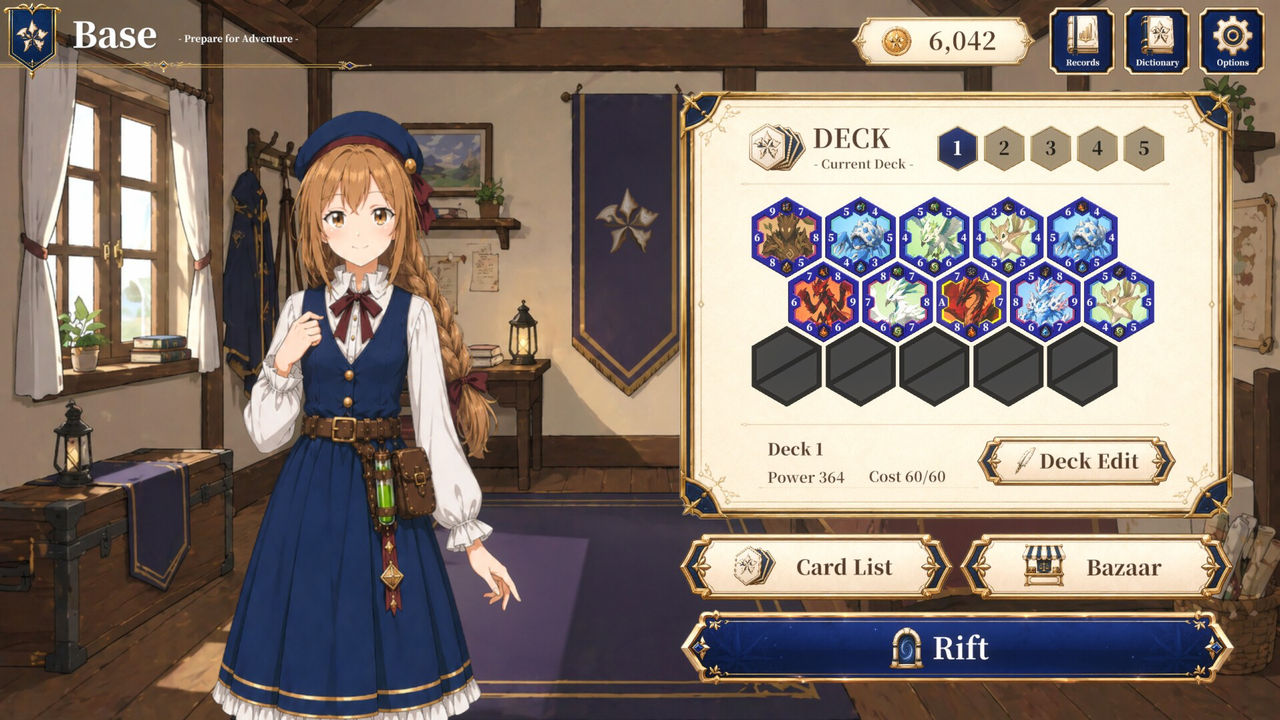
The store page is explicit that every choice changes the shape of your deck, which is what lets you adapt as a run progresses, and the base phase is where those picks turn into a longer-term collection: cards can be bought and sold, and fused into stronger ones. Between the run deck that grows mid-expedition and the saved decks you refine at base, Hex Reverse keeps two deck layers, and the gameplay page covers how they feed into the Rift difficulty ladder. For the individual achievement names tied to that base loop, see the achievements page.
FAQ
How many values does a Hex Reverse card have?
Six, one for each side of the card. The Steam description says each card has six values, one for each side, and only the values on the edges that touch another card are ever compared. That means a card is effectively six separate numbers, each one only relevant depending on where you place it and what is next to it.
When does a card flip in Hex Reverse?
When it is adjacent to a card whose touching value is higher. The store page describes it directly: when you place a card next to an opponent's card, the values on the touching edges are compared, and if your value is higher the opposing card flips to your side. Nothing happens when your value is lower or equal, so flips depend on which edge is actually in contact.
Can your own cards flip back?
The store page only describes flips in one direction, from the opponent to you, so whether a card you own can be flipped back is not documented yet. What is documented is that the opponent places cards too, and that special rules and unique field conditions can change how a battle plays out, which is the mechanism the page points to for unusual situations.
How do you get new cards during a run?
By winning battles. The Steam description says each run consists of a series of battles, and that after winning a battle you choose one card from a selection taken from your opponent's deck. The card is added directly to your current run deck and can be used in the battles ahead, so the deck you finish a run with is built out of what you took from your opponents.
Are there card names or a full card list for Hex Reverse?
No card names or values are published. The store page explains the six-value structure, the edge comparison and how cards are added to your run deck, but it does not list individual cards, their stats, their rarities or the size of the card pool. A full card list is therefore not documented yet.
More in Mechanics
More mechanics pages in Hex Reverse.
- Hex Reverse Bazaar — Buying, Selling Cards and the Gold LoopGuideUpdated 2026-10-08
- Hex Reverse Controls — Keyboard, Mouse and Controller SupportGuideUpdated 2026-10-08
- Hex Reverse Features — Hex Battles, Deckbuilding and ProgressionGuideUpdated 2026-10-08
- Hex Reverse Fusion — Fusing Cards Into Stronger S-Rank CardsGuideUpdated 2026-10-08
References
- Hex Reverse on Steam
- Hex Reverse Steam Community Hub
- Hex Reverse appdetails (Steam Store API, frozen 2026-10-08)
Facts on this page are compiled from the references above. Items marked "to confirm" are single-source and not yet verified.