
Hex Reverse · Mechanics · Guide
Hex Reverse Features — Hex Battles, Deckbuilding and Progression
Hex Reverse features a 19-space hex battlefield, edge-comparison flips, SP skills, elemental cards, and permanent base progression between every run.
By the New Game Wiki team · Updated 2026-10-08
On this page (8)
- Battle and Deckbuilding Features
- Progression Between Runs
- Steam, Accessibility and Quality-of-Life Features
- What are the main features of Hex Reverse?
- Does Hex Reverse have multiplayer or co-op?
- Does Hex Reverse support Steam Workshop or mods?
- What makes Hex Reverse different from other deckbuilders?
- How does progression work between runs in Hex Reverse?
Hex Reverse features come from one idea: a card battler where the board is the scoreboard. Instead of chipping away at a health bar, you place cards on a field of 19 hexagonal spaces and fight over territory by comparing the values on the edges that touch enemy cards. Around that sit a roguelike run structure, a base phase between runs, and a modest set of Steam features.
Battle and Deckbuilding Features
The battle system is built on placement rather than damage. Battles take place on a field of 19 hexagonal spaces where you and your opponent take turns placing cards, and each card carries six values, one for every side. When you place a card next to an opponent's card, the values on the touching edges are compared, and if your value is higher the opposing card flips to your side.
| Feature | What the store page says |
|---|---|
| Hex battlefield | Battles take place on a field of 19 hexagonal spaces |
| Six-value cards | Each card has six values, one for each side |
| Edge comparison | Values on touching edges are compared when cards are adjacent |
| Flipping | A higher value flips the opposing card to your side |
| Run deckbuilding | After a win, pick one card from your opponent's deck for your current run deck |
| SP skills | Strengthen cards, change elements, weaken opponents, draw cards, alter battle flow |
| Field conditions | Special rules and unique field conditions change how battles play out |
The deckbuilding layer is the roguelike half. Each run consists of a series of battles, and every won battle lets you choose one card from a selection taken from your opponent's deck, added directly to the run deck you are carrying. The store page notes that every choice changes the shape of your deck, which is what lets a run adapt as the battles get harder.

Progression Between Runs
The part that outlives a single run happens at your base. After a run ends you return there and prepare for the next expedition, and the store description lists the options: build and refine saved decks, buy and sell cards, fuse cards into stronger ones, and upgrade equipment that provides permanent progression. The stated purpose is to strengthen your collection, improve your setup, and take on increasingly difficult Rifts.
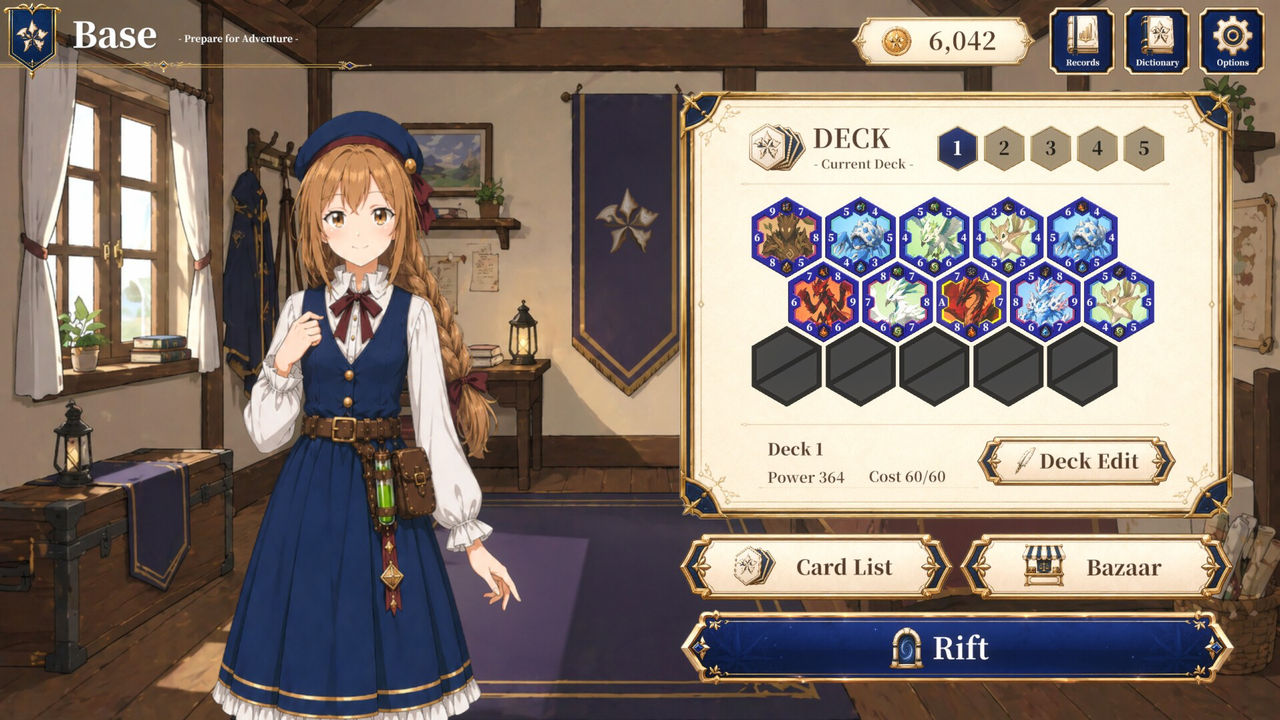
That split is what makes Hex Reverse a roguelike deckbuilder rather than a straight card game: the run is the repeatable unit, and the base, the shop and the fusion bench are where the results of a run turn into a better starting position for the next one. It also means the difficulty curve is expressed through the Rifts you unlock rather than through a difficulty menu.
Steam, Accessibility and Quality-of-Life Features
The store-side feature set is deliberately small, and it is worth listing in full because several items speak to how the game is meant to be played: nothing in it is time-critical.
| Steam feature | Included |
|---|---|
| Single-player | Yes |
| Steam Achievements | Yes, 27 in total |
| Steam Cloud | Yes |
| Family Sharing | Yes |
| Custom Volume Controls | Yes |
| Playable without Timed Input | Yes |
| Save Anytime | Yes |
| Touch Only Option | Yes |
| Controller support | Not listed |
| Steam Workshop | Not listed |
| Multiplayer or co-op | Not listed |
| Demo | Not listed |
Two absences are as informative as the presences. There is no multiplayer, co-op or PvP, so every battle is against the game, and there is no Workshop support, so there is no documented modding scene. Combined with save anytime and no timed input, the intended experience is a solo, unhurried card game you can put down mid-battle. For the language list and store situation, see the platforms page; for what a card actually carries, see the cards page.
FAQ
What are the main features of Hex Reverse?
A hexagonal territory-control card battle system on a 19-space field, roguelike deckbuilding where each won battle lets you take a card out of your opponent's deck, SP-driven skills with element changes and special battle conditions, and a base phase between runs where you build decks, trade and fuse cards and upgrade equipment for permanent progression. It is single-player only and released on Windows on 7 October 2026.
Does Hex Reverse have multiplayer or co-op?
No. The Steam store page lists single-player only, and no co-op, multiplayer, PvP or online mode appears anywhere in the listing. The opponent in each battle is the game's AI, and progression is built around solo runs that end in a base phase rather than around matchmaking.
Does Hex Reverse support Steam Workshop or mods?
No Steam Workshop support is listed. The store page's feature list covers single-player, Steam achievements, custom volume controls, playable without timed input, save anytime, a touch-only option, Steam Cloud and Family Sharing, and Workshop does not appear among them. Mod support is therefore not documented.
What makes Hex Reverse different from other deckbuilders?
The board. Instead of attacking a health total, you place cards on a field of 19 hexagonal spaces and compare the values on the edges that touch enemy cards; if your value is higher, the opposing card flips to your side. Cards carry six values, one per side, so placement decides which value is ever tested, and territory rather than damage is the thing you are fighting over.
How does progression work between runs in Hex Reverse?
After a run ends you return to your base. The store description lists building and refining saved decks, buying and selling cards, fusing cards into stronger ones and upgrading equipment that provides permanent progression, with the stated goal of strengthening your collection and taking on increasingly difficult Rifts. Equipment upgrades are the part explicitly described as permanent.
More in Mechanics
More mechanics pages in Hex Reverse.
- Hex Reverse Bazaar — Buying, Selling Cards and the Gold LoopGuideUpdated 2026-10-08
- Hex Reverse Cards — Six Values, Edge Flips and Deck GrowthGuideUpdated 2026-10-08
- Hex Reverse Controls — Keyboard, Mouse and Controller SupportGuideUpdated 2026-10-08
- Hex Reverse Fusion — Fusing Cards Into Stronger S-Rank CardsGuideUpdated 2026-10-08
References
- Hex Reverse on Steam
- Hex Reverse Steam Community Hub
- Hex Reverse appdetails (Steam Store API, frozen 2026-10-08)
Facts on this page are compiled from the references above. Items marked "to confirm" are single-source and not yet verified.