
Hex Reverse · Getting Started · Guide
Hex Reverse Beginner Guide — First Hour, Core Loop and Common Stumbles
This Hex Reverse beginner guide covers the first hour: the 19-space hex board, how edge values flip cards, and how to grow a deck that survives later Rifts.
By the New Game Wiki team · Updated 2026-10-08
On this page (10)
- What Your First Hour Looks Like
- Reading the Board Instead of Chasing Big Numbers
- Where New Players Get Stuck
- Between Runs: Base, Shop and Fusion
- Where to Go After Your First Run
- What kind of game is Hex Reverse?
- How do you win a battle in Hex Reverse?
- How big is the Hex Reverse board?
- What happens between runs in Hex Reverse?
- Does Hex Reverse have multiplayer or a campaign?
A Hex Reverse beginner guide comes down to one sentence: this is a single-player roguelike deckbuilder played as a territorial duel on a board of 19 hexagonal spaces. You and your opponent take turns placing cards, and every card carries six values, one for each side. When your card touches an opponent's card, the two touching edges are compared, and the higher value flips the enemy card to your side. There is no campaign, no multiplayer and no controller requirement, so the skill ceiling is board reading and deck shape rather than reflexes.
What Your First Hour Looks Like
Hex Reverse does not hide behind a long tutorial campaign, so the fastest way to learn is to treat your first run as a guided experiment rather than a score attempt. A run is a series of battles, and every battle happens on the same kind of 19-space field: you place a card, the game compares the edges that touch enemy cards, and anything you outnumber changes owner. After a battle you choose one card from a selection taken from your opponent's deck, and that card goes straight into the deck you are carrying through the run.
| Step | What you do | What it moves |
|---|---|---|
| Place a card | Drop it on an empty hex beside enemy cards | One or more edge comparisons |
| Compare edges | The touching values are checked for you | Flips, or nothing if your value is lower |
| Flip | An enemy card switches to your side | Territory and board control |
| Finish the battle | Hold more of the field than your opponent | One card pick from the enemy deck |
| Return to base | Spend the results of the expedition | Permanent progression for later runs |
The last row matters more than it looks. The store page describes the loop as building your deck as the run unfolds, then returning to your base after the run ends to prepare for the next expedition, which means a bad individual battle is usually a lesson rather than a dead end.
Reading the Board Instead of Chasing Big Numbers
New players tend to hunt for the card with the largest total. The Steam description pushes you in the opposite direction: choose your position carefully, read the board, and use each card's strengths to take control of as much territory as possible. Since only the touching edges are compared, an enormous value on one side is a weapon when that side faces the enemy and a liability when it does not.

Six values also means six jobs. A card you slide in to flip one neighbour may leave its opposite edge wide open to the next card your opponent places beside it, so the practical habit worth building in hour one is counting how many of your six edges touch enemy cards before you commit. Cards are defined by more than their values as well: the store page notes that SP can be spent on skills which strengthen cards, change their element, weaken opponents, draw additional cards and alter the flow of battle, and that special rules and unique field conditions can change how any given battle plays out.
Where New Players Get Stuck
- Chasing the biggest number on a card instead of the edge that actually faces the enemy, which wastes the cards with one strong side and five weak ones.
- Ignoring SP and skills for the first several runs, then finding later battles harder than they need to be because cards were never strengthened or re-elemented.
- Committing every card to one side of the 19-space field, so a single enemy flip cascades back across the territory you just took.
- Treating the post-battle card pick as a collection screen instead of a deck decision, even though each pick changes the shape of the deck you will play in the battles ahead.
- Expecting the run deck to be your only deck, when the base loop also lets you build and refine saved decks and fuse cards into stronger versions.
Between Runs: Base, Shop and Fusion
The expedition is only half of Hex Reverse. After a run ends, you return to your base and prepare for the next one. The Steam description lists the between-run activities as building and refining saved decks, buying and selling cards, fusing cards into stronger ones, and upgrading equipment that provides permanent progression. The stated purpose of all of it is to strengthen your collection, improve your setup, and take on increasingly difficult Rifts, which is the name the store page uses for the escalating challenge that follows each expedition.
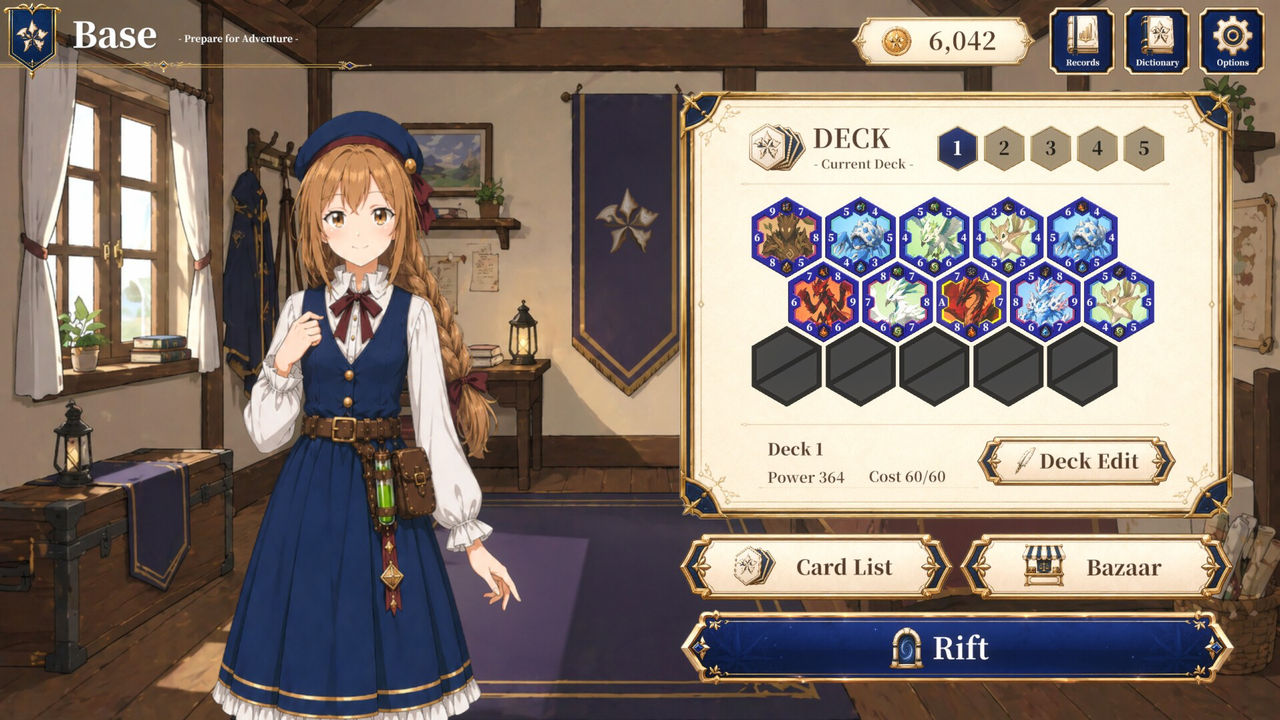
That structure explains why the game is described as a roguelike deckbuilder rather than a pure card battler: the individual run is the repeatable unit, and the base, the shop and the fusion bench are where a run's results turn into a stronger starting position for the next one.
Where to Go After Your First Run
Once the flip rule feels automatic, the next useful reads are mechanical rather than introductory. The cards page breaks down what a card carries, how adjacent edges decide a flip and how the run deck grows; the gameplay page covers the full loop including SP, elements and what a lost run actually costs; and the achievements page lists the 27 Steam achievements with the ten names the store page has published so far. If you have not installed it yet, the release-date page explains the launch pricing window, which is worth reading before the free period ends.
FAQ
What kind of game is Hex Reverse?
It is a single-player roguelike deckbuilding card game played as a territorial duel on a hexagonal battlefield, developed and published by IsaoWorks. The Steam short description calls it a roguelike deckbuilding card game where you place cards, compare the values on adjacent edges and flip enemy cards to your side. It released on 7 October 2026 for Windows, with English and Japanese listed as supported languages.
How do you win a battle in Hex Reverse?
By taking and holding more of the board than your opponent. Battles happen on a field of 19 hexagonal spaces where the two sides alternate placing cards, and each card has six values, one for every side. When you place a card next to an opponent's card, the values on the touching edges are compared, and if your value is higher the opposing card flips to your side. The store page does not spell out a separate ending condition beyond controlling territory, so treat most-territory as the working assumption rather than a documented rule.
How big is the Hex Reverse board?
19 hexagonal spaces. That is the number the Steam description gives, and the same description describes the two players taking turns placing cards on that field. Because the field is small, every empty space matters and a card placed in the wrong corner can leave two or three of its six edges exposed at once.
What happens between runs in Hex Reverse?
You return to your base and prepare for the next expedition. The Steam description lists the between-run options as building and refining saved decks, buying and selling cards, fusing cards into stronger ones, and upgrading equipment that provides permanent progression. Each finished run therefore feeds a longer-term setup rather than resetting your whole account.
Does Hex Reverse have multiplayer or a campaign?
No. The Steam store page lists single-player only, with Steam achievements, Steam Cloud, Family Sharing, save-anytime and custom volume controls as the accompanying features. There is no co-op, no multiplayer and no campaign structure described anywhere on the listing, and the run sequence of battles is the progression path instead.
More in Getting Started
More getting started pages in Hex Reverse.
- Hex Reverse Walkthrough — From Your First Run to a Stable SetupGuideUpdated 2026-10-08
References
- Hex Reverse on Steam
- Hex Reverse Steam Community Hub
- Hex Reverse appdetails (Steam Store API, frozen 2026-10-08)
Facts on this page are compiled from the references above. Items marked "to confirm" are single-source and not yet verified.