
DustFall · Mechanics · Guide
DustFall Gameplay — The Descent Loop, Payloads and the Surface Scan
DustFall gameplay explained: the descent loop, the surface scan and its hunters, payloads and three-way upgrades, six ruins, six core bosses and Cataclysm Mode.
By the New Game Wiki team · Updated 2026-10-14
On this page (10)
- The Core Loop: Descend, Destroy, Upgrade
- The Surface Scan and Hunter Pressure
- Payloads, Upgrades and Builds
- Six Layers and Their Core Bosses
- Failure, Difficulty and Pacing
- What genre is DustFall?
- What is the core loop in DustFall?
- What happens when the surface scan detects you in DustFall?
- How many layers and bosses are in DustFall?
- Does progress carry over between runs in DustFall?
DustFall gameplay is a loop of downward motion under a clock. You play a single-player descent roguelite shooter beneath an alien-occupied surface, the scan above you is always closing in, and the only way to reach the next ruin is to destroy a path to the bottom of the current one. The store page is specific about the systems involved — destructible pixel terrain, fires, cave-ins, payload builds and a three-way upgrade choice — and deliberately vague about story, which is why this page sticks to what the mechanics actually do.
The framing line is blunt: the surface has fallen and down is your only way forward. Everything the game asks of you follows from that, because there is no surface to return to and no route that is not dug.
The Core Loop: Descend, Destroy, Upgrade
A run is a descent. You blast through the strata, trigger cave-ins, and dive deeper, and every act of destruction is both a movement tool and a combat tool. The loop only pays out at the layer core: reaching the bottom of a layer and defeating its core is what lets you fall into the next ruin.
| Stage | What the store page says happens |
|---|---|
| Enter a descent | The surface scan begins to close in from the start |
| Dig down | You blast strata, ignite oil, detonate powder caches and trigger cave-ins |
| Build up | Three-way upgrades each descent: enhance weapon, gain a passive, or switch payload |
| Finish the layer | Reach the bottom and defeat the core boss to fall into the next ruin |
| Repeat | Six buried ruins, each with its own materials, reactions and enemy ecosystem |
The consequence of that structure is that destroying terrain is not optional decoration. Every tunnel you carve and every cavity you blast open changes the battle and your escape route, which means map control and firepower are the same resource in this game.
The Surface Scan and Hunter Pressure
The scan is the pacing system. It starts closing in the moment a descent begins, and the store page states that staying too close to the upper layers gets you detected, which draws increasingly dangerous hunters down from above. Dig beyond the scan's reach and you earn a brief moment of safety rather than permanent escape.
That single rule does most of the work in DustFall. It punishes backtracking and shallow farming, it converts depth into safety, and it means the correct answer to a hard fight is often to keep digging rather than to clear the room. The escalating danger also implies the pressure grows with time, not just with depth.
Payloads, Upgrades and Builds
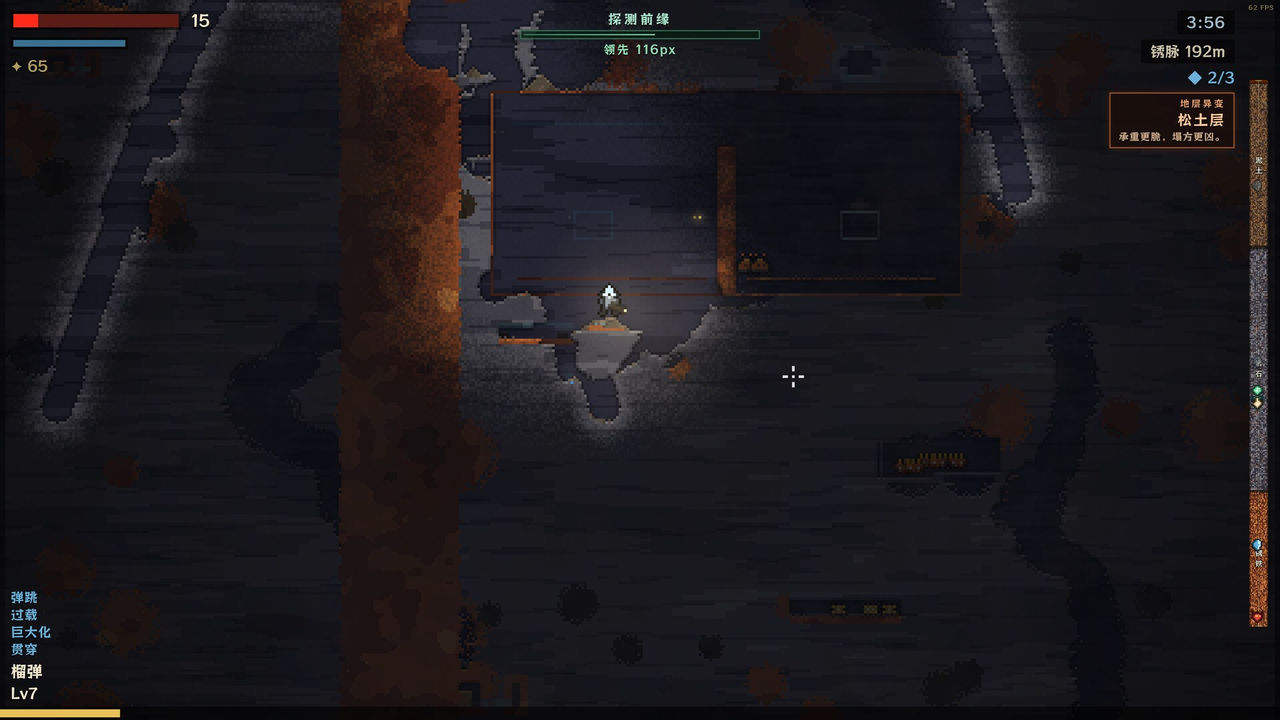
DustFall frames weapons as payloads and upgrades rather than a fixed arsenal. The store page names the Drill Round and the Grenade as examples of starting payloads, and says builds are freely combinable payloads and upgrades. Each descent then offers the same three-way choice.
- Enhance your weapon, for a stronger version of the payload you already carry.
- Gain a passive ability, for a build effect that is not tied to a single shot.
- Switch payloads, which is the flexible option when a layer's terrain does not suit your current tool.
The three branches are cheap to describe and hard to choose between, because the layers differ. A payload that opens rock efficiently is a different proposition in a layer built around combustibles, and the store page is explicit that each of the six layers has its own terrain materials and environmental reactions.
Six Layers and Their Core Bosses
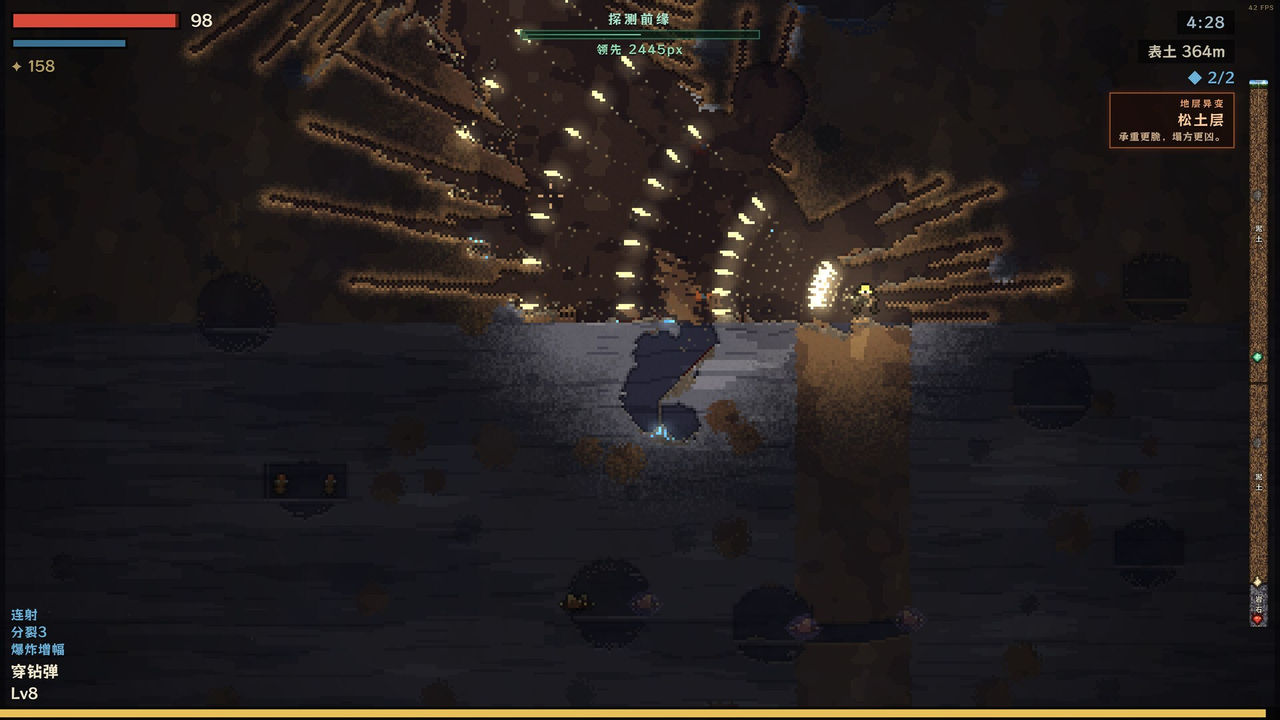
The campaign is built from six buried ruins. Each has its own terrain materials, environmental reactions, enemy ecosystem and core boss, and the ruins and echoes buried in the strata carry the story of people who also dug downward looking for somewhere to live.
The unanswered question the store page poses is whether there is really a home beneath the earth, and the mechanical answer is structural: because a layer only ends at its core, the boss is a gate rather than an optional challenge. After the ending the game opens Cataclysm Mode, and the store page lists three endings in total.
Failure, Difficulty and Pacing
Death in DustFall ends a run, but the store page does not quantify the restart cost. What it does document on the difficulty side is smaller: the Steam store categories include Adjustable Difficulty, Playable without Timed Input and Playable at your own pace, which is the clearest official signal about how the pace can be tuned.
That sits beside a scan that visibly closes in, so treat the pacing tags as options rather than as a claim that the game has no pressure. What is not documented in any source used here is what carries over between runs, how long a full clear takes, the individual payload statistics, and the names of the six core bosses — all not documented yet. For the terrain tools themselves, see the weapons page; for the run structure in order, see the beginner guide.
FAQ
What genre is DustFall?
The store page calls it a single-player descent roguelite shooter. The Steam store API files it under the Adventure genre and lists it as single-player only, with no co-op or multiplayer categories. The descent framing is literal: the game takes place underground and the surface has already been lost to alien life.
What is the core loop in DustFall?
Descend, destroy, upgrade. You dig down through destructible pixel terrain, the surface scan closes in behind you, and each descent offers three-way upgrades: enhance your weapon, gain a passive ability, or switch payloads. Reaching the bottom of a layer and defeating its core is what lets you fall into the next ruin.
What happens when the surface scan detects you in DustFall?
Hunters descend from above. The store description says the scanning front pushes steadily deeper underground, that staying too close to the upper layers gets you detected, and that detection draws increasingly dangerous hunters. Digging beyond the scan's reach buys only a brief moment of safety.
How many layers and bosses are in DustFall?
Six layers and six core bosses. The store page states that each of the six buried ruins has its own terrain materials, environmental reactions, enemy ecosystem and core boss, and that reaching the bottom of a layer and defeating its core is the only way into the next one.
Does progress carry over between runs in DustFall?
Not documented yet. The store page describes freely combinable payloads and upgrades within a descent and calls the game a roguelite, but it does not state what persists after death or what the restart cost is, so any meta-progression is unconfirmed.
More in Mechanics
More mechanics pages in DustFall.
- DustFall Cataclysm Mode — The Post-Ending Mode on SteamGuideUpdated 2026-10-14
- DustFall Controls — Keyboard and Mouse on WindowsGuideUpdated 2026-10-14
- DustFall Features — Destructible Terrain, Payloads and Six RuinsGuideUpdated 2026-10-14
- DustFall Hunters — The Surface Scan and How It Finds YouGuideUpdated 2026-10-14
References
- DustFall on Steam
- DustFall appdetails (Steam store API, US English)
- DustFall — Steam Community Hub
- DustFall — Steam Discussions
Facts on this page are compiled from the references above. Items marked "to confirm" are single-source and not yet verified.