
DustFall · Getting Started · Guide
DustFall Beginner Guide — Your First Descent, Payloads and Terrain
A DustFall beginner guide to your first descent: starting payloads, the three-way upgrade choice, the surface scan and using fires and cave-ins to survive.
By the New Game Wiki team · Updated 2026-10-14
On this page (11)
- The First Descent, Step by Step
- The Surface Scan and Why You Cannot Stay Shallow
- The Terrain Is Your Weapon
- Building Through Three-Way Upgrades
- The Mistakes That End Early Runs
- What Comes After the First Ruins
- What should I do first in DustFall?
- How do I stop the surface scan from finding me in DustFall?
- What are the three upgrade choices in DustFall?
- How many ruins and bosses does DustFall have?
- Is DustFall hard for a new player?
DustFall is small enough to learn in a single descent: you choose a starting payload, dig downward through destructible pixel terrain, and reshape your build three times over before the surface scan closes in on you. The beginner guide below covers what the first ruin actually asks of you, which early choices matter, and the two habits that end most runs — camping near the surface and digging without checking what the collapse will bring down.
The game is a single-player descent roguelite shooter from LeoGame, released on October 1, 2026 at $1.79 in the US on Windows. Alien life has overrun the surface, and the loop never asks you to reclaim it. Down is the only direction the game offers, which is also why the shortest path to understanding it is to treat the first layer as a tutorial you replay rather than a place to win.
The First Descent, Step by Step
The store page describes the run structure in plain terms: blast through the strata, trigger cave-ins, dive deeper. You move downward, the scan follows, and the only way into the next ruin is to reach the bottom of the current one and defeat its core. Everything else in the game — payloads, upgrades, terrain reactions — is a tool for that one job.
| Choice | What the official store page documents |
|---|---|
| Starting payload | Payloads such as the Drill Round or the Grenade are named as examples |
| First run goal | Reach the bottom of the layer and defeat its core to fall into the next ruin |
| Upgrade branch | Enhance your weapon, gain a passive ability, or switch payloads |
| Build shape | Roguelite builds with freely combinable payloads and upgrades |
| Route | Every tunnel you carve and cavity you blast open changes the battle and your escape route |
Before you worry about builds, learn what the terrain does when it is disturbed. That single piece of knowledge carries a new player through the first ruin faster than any upgrade order.
The Surface Scan and Why You Cannot Stay Shallow
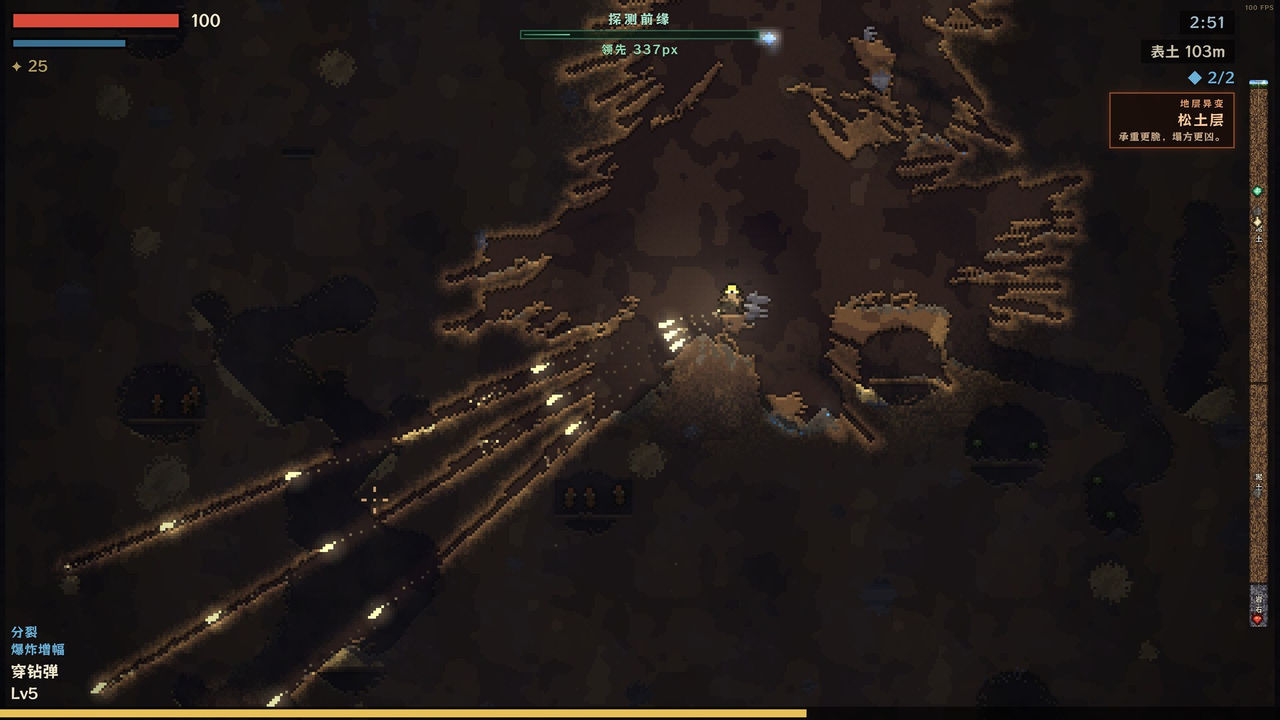
The scan is the pressure that defines the whole game. At the start of every descent it begins to close in from above; stay too close to the upper layers and you will be detected, which draws increasingly dangerous hunters down after you. Dig beyond the scan's reach and you earn a brief moment of safety — brief, because the front keeps pushing deeper.
That means the shallow layers you have already cleared are not a safe place to farm. A run that stalls near the top is a run that is actively being squeezed, and the hunters that arrive are described as increasingly dangerous rather than fixed in strength. Read the scan as a clock, not as a stealth system.
The Terrain Is Your Weapon
The underground is made of pixels that flow, burn, explode and collapse, and the store page frames almost every environmental tool as an offensive one. Ignite oil and let fire spread through the terrain. Detonate powder caches to blast a route through solid rock. Remove crucial supports and bring a collapse down on your enemies.
The trade-off is written into the same paragraph: every act of destruction may open a path to survival, or bring an entire ruin down on top of you. If you are new, the practical rule is to treat fire as area denial and supports as a trap you set deliberately, not as scenery you happen to break while digging. The weapons page goes through payload combinations and terrain reactions in more detail.
Building Through Three-Way Upgrades
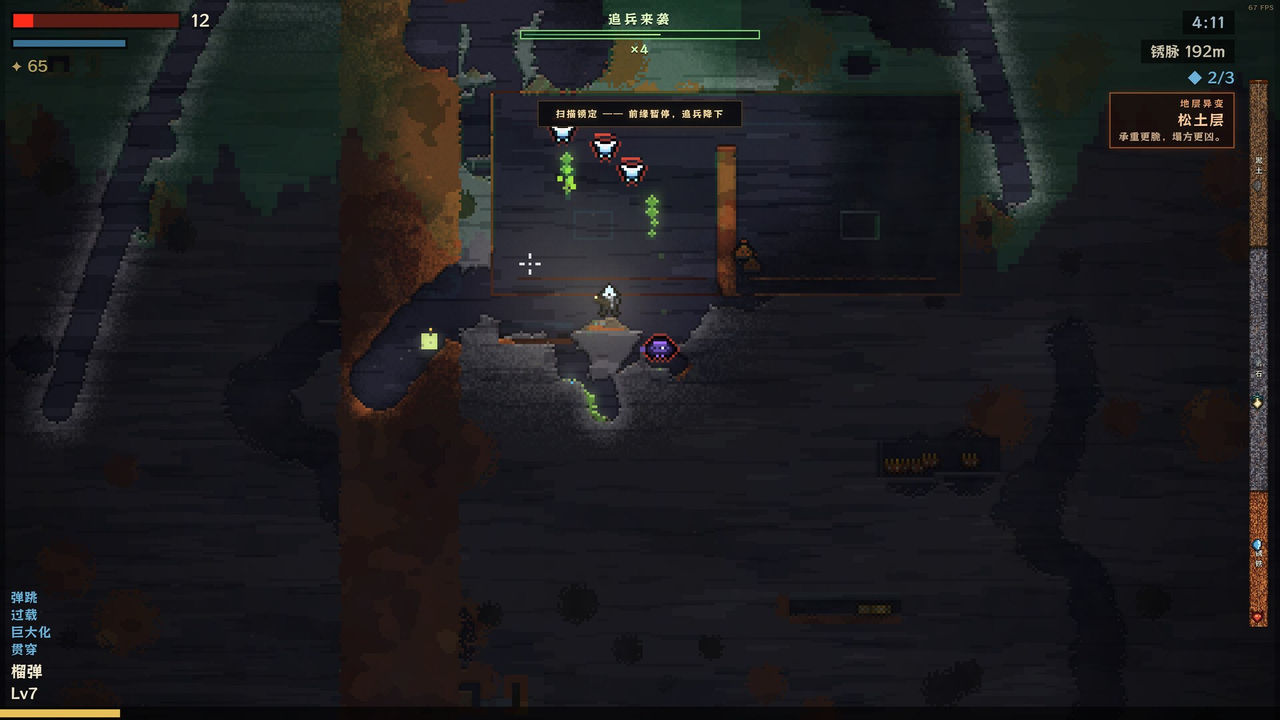
Each descent offers the same three-way choice: enhance your weapon, gain a passive ability, or switch payloads. The store page presents these as freely combinable rather than as a locked class tree, so the build you end a run with is something you steer as the layer teaches you what it is made of.
Because the six layers have different terrain materials, environmental reactions and enemy ecosystems, a payload that feels strong in one ruin can be the wrong tool in the next. That is the argument for keeping the switch-payload branch in play instead of pouring everything into one weapon.
The Mistakes That End Early Runs
The documented failure states are simple, and most beginner deaths come from them rather than from enemy damage.
- Staying near the surface too long, which triggers detection and escalating hunters.
- Digging straight down through supporting rock and burying yourself in the collapse you caused.
- Ignoring the oil and powder caches in the terrain and fighting every enemy with the base payload.
- Committing to one payload before seeing what the new layer is built from.
- Forgetting that the run ends at the layer core, not at the last enemy standing in the way.
What Comes After the First Ruins
There are six layers in total, and the store page says each one has its own terrain materials, environmental reactions, enemy ecosystem and core boss. Beyond the campaign content it lists three endings plus a Cataclysm Mode that unlocks after the ending, which is where a player who has learned the terrain loop will eventually want to go.
For the mechanics behind the loop, the gameplay page breaks down the scan, the upgrades and the failure rules; for when the game launched and what it costs, see the release date page. The exact effects of individual payloads, the names of the six cores and the unlock order of upgrades are not documented on the store page, so treat them as not documented yet until a source publishes them.
FAQ
What should I do first in DustFall?
Start a descent, choose your opening payload from the options the store page names (the Drill Round or the Grenade are the two examples it gives), and dig downward. Your first real decision is the three-way upgrade, where you either enhance your weapon, take a passive ability or switch payloads. The store page describes the whole game as blasting through strata, triggering cave-ins and diving deeper, so early progress is about depth rather than clearing an area.
How do I stop the surface scan from finding me in DustFall?
Keep digging. The store description states that at the start of every descent the surface scan begins to close in, and that staying too close to the upper layers gets you detected and draws increasingly dangerous hunters. It adds that digging beyond the scan's reach earns a brief moment of safety, which is the game's way of pushing you down instead of letting you farm the shallow layers.
What are the three upgrade choices in DustFall?
The store description lists three-way upgrades during each descent: enhance your weapon, gain a passive ability, or switch payloads. It describes builds as freely combinable payloads and upgrades, so the choice is not a one-off class pick but something you reshape as a run goes on.
How many ruins and bosses does DustFall have?
Six layers, each with its own core boss. The store page says only that reaching the bottom of a layer and defeating its core lets you fall into the next ruin, and that each of the six layers has its own terrain materials, environmental reactions, enemy ecosystem and core boss.
Is DustFall hard for a new player?
The pressure comes from a timer rather than a steep stat wall. The scan closes in from the moment a descent starts, hunters arrive once you are detected, and the terrain you destroy can also bury you: the store page notes that every act of destruction may open a path to survival or bring an entire ruin down on top of you. Staying shallow is punished, and careless collapses hurt you as much as the enemies do.
More in Getting Started
More getting started pages in DustFall.
- DustFall Walkthrough — From First Descent to the Sixth RuinGuideUpdated 2026-10-14
References
- DustFall on Steam
- DustFall — Steam Community Hub
- DustFall appdetails (Steam store API, US English)
- DustFall — Steam News Hub
Facts on this page are compiled from the references above. Items marked "to confirm" are single-source and not yet verified.