
DustFall · Mechanics · Guide
DustFall Features — Destructible Terrain, Payloads and Six Ruins
DustFall features: fully destructible pixel terrain, roguelite payload builds, a closing surface scan, six buried ruins, six core bosses and three endings.
By the New Game Wiki team · Updated 2026-10-14
On this page (8)
- Destructible Pixel Terrain and Environmental Reactions
- Roguelite Builds, Payloads and Descent Pressure
- Six Layers, Three Endings and Cataclysm Mode
- What are the main features of DustFall?
- What makes the terrain in DustFall different?
- What is Cataclysm Mode in DustFall?
- Does DustFall have difficulty options?
- Is DustFall single-player only?
DustFall features a short, specific set of systems rather than a long bullet list: a fully destructible simulated pixel underground, roguelite builds with freely combinable payloads and upgrades, constant pressure from a surface scan that pushes you deeper, six buried layers with six core bosses, and three endings with a Cataclysm Mode unlocked afterwards. Everything the store page advertises sits inside that one sentence.
The features below are taken from the official store description and the store API categories. Where a feature is named but not explained, this page says so instead of filling the gap.
Destructible Pixel Terrain and Environmental Reactions
The headline feature is terrain that behaves like material rather than like a wall. The store page describes the underground as pixels that flow, burn, explode and collapse, and gives three concrete interactions: ignite oil and let fire spread, detonate powder caches to blast through solid rock, and remove crucial supports to bring a collapse down on enemies.
The design promise is that this changes both the fight and the route, because every tunnel you carve and every cavity you blast open alters the battle and your escape route. The same page includes the downside in the same breath: every act of destruction may open a path to survival or bring an entire ruin down on top of you.
| Advertised feature | What the store page states |
|---|---|
| Fully destructible terrain | Simulated pixel terrain that is fully destructible |
| Fire | Ignite oil and let fire spread through the terrain |
| Explosions | Detonate powder caches to blast a route through solid rock |
| Collapse | Remove crucial supports to bring a collapse down on enemies |
| Consequence | Destruction can save you or bury you |
Roguelite Builds, Payloads and Descent Pressure
Builds are the second pillar. The store page advertises roguelite builds with freely combinable payloads and upgrades, names the Drill Round and the Grenade as examples of starting payloads, and offers a three-way upgrade each descent: enhance your weapon, gain a passive ability, or switch payloads.
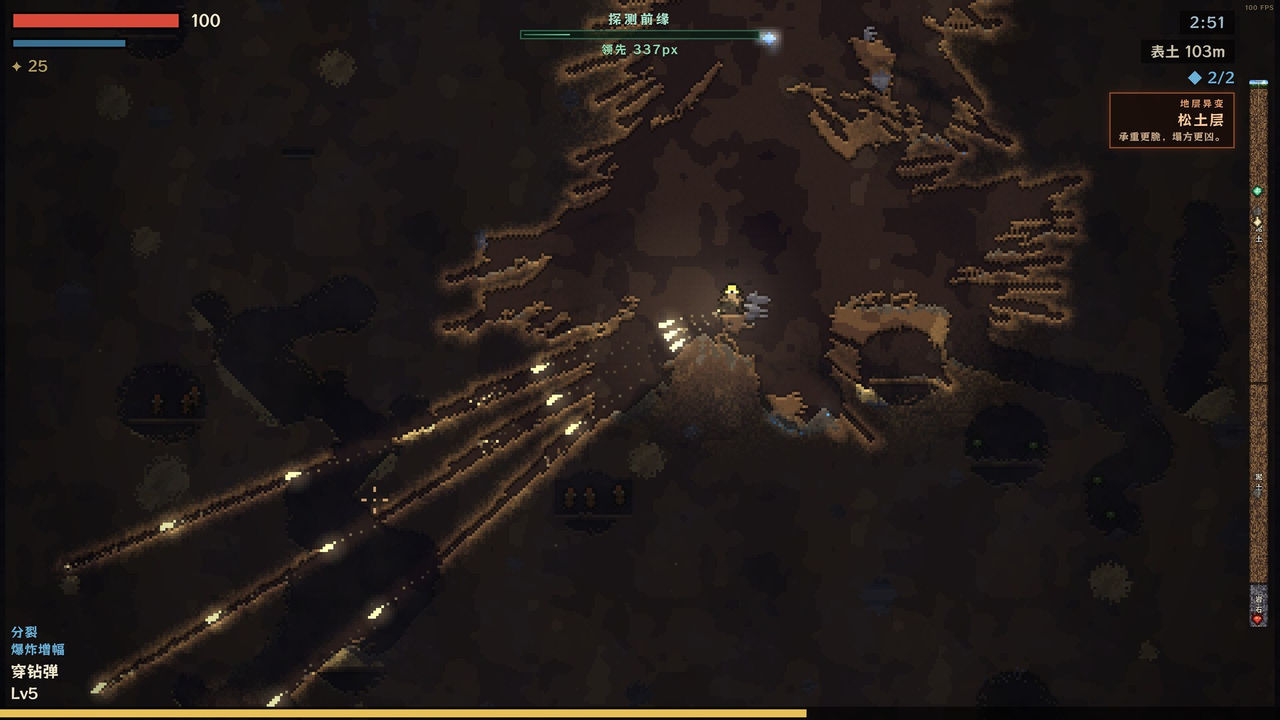
Running alongside that is the feature the game uses as a clock: constant descent pressure from the surface scan and alien hunters. The scan begins closing in at the start of every descent, staying near the upper layers gets you detected, and detection brings increasingly dangerous hunters down from above. Digging beyond the scan's reach earns only a brief moment of safety, which is what stops the feature from becoming an idle timer.
Six Layers, Three Endings and Cataclysm Mode
The scope features are stated as numbers. Six layers, each with its own terrain materials, environmental reactions, enemy ecosystem and core boss, and reaching the bottom of a layer and defeating its core is the only way into the next ruin.
- Six layers, each with its own materials, reactions, enemies and core boss.
- Three endings, according to the store description.
- Cataclysm Mode, unlocked after the ending.
- Not documented yet: what Cataclysm Mode changes, and the names of the cores.
The Steam feature list adds the supporting details rather than new systems: single-player, Steam Achievements, Steam Cloud and Family Sharing, plus Custom Volume Controls, Stereo Sound, Adjustable Difficulty, Playable without Timed Input and Playable at your own pace. Taken together, they describe a compact, offline, single-character roguelite. For how the pieces fit into a run, see the gameplay page; for the hardware all of this runs on, see the system requirements page.
FAQ
What are the main features of DustFall?
The store description lists five: fully destructible, simulated pixel terrain; roguelite builds with freely combinable payloads and upgrades; constant descent pressure from the surface scan and alien hunters; six layers and six core bosses; and three endings plus a Cataclysm Mode after the ending.
What makes the terrain in DustFall different?
It is simulated rather than scripted. The underground is made of pixels that flow, burn, explode and collapse, so ignited oil spreads through the terrain, powder caches blast routes through solid rock, and removing supports brings a collapse down on enemies. The same description warns that every act of destruction can also bury you.
What is Cataclysm Mode in DustFall?
Cataclysm Mode is listed as content that opens after the ending, in the same store bullet that confirms three endings. The listing does not describe what changes in the mode, so its rules are not documented yet.
Does DustFall have difficulty options?
Adjustable Difficulty is listed among the store categories, alongside Playable without Timed Input and Playable at your own pace. That combination suggests the pace at which the scan closes in can be managed, but the store page does not explain each difficulty setting in detail.
Is DustFall single-player only?
Yes. The store listing carries the single-player category and no co-op, multiplayer or online categories, and the description describes the whole game as a solo descent beneath an alien-occupied surface.
More in Mechanics
More mechanics pages in DustFall.
- DustFall Cataclysm Mode — The Post-Ending Mode on SteamGuideUpdated 2026-10-14
- DustFall Controls — Keyboard and Mouse on WindowsGuideUpdated 2026-10-14
- DustFall Gameplay — The Descent Loop, Payloads and the Surface ScanGuideUpdated 2026-10-14
- DustFall Hunters — The Surface Scan and How It Finds YouGuideUpdated 2026-10-14
References
Facts on this page are compiled from the references above. Items marked "to confirm" are single-source and not yet verified.