
Hex Reverse · Mechanics · Guide
Hex Reverse Packs — Random Card Packs and S-Rank Pulls
Hex Reverse packs are random: the achievement list tracks getting an S-rank card from a random pack, and no pack contents, prices or drop rates are published.
By the New Game Wiki team · Updated 2026-10-08
On this page (7)
Hex Reverse packs are random card packs, and the achievement list is the source that confirms them: one goal is earned by obtaining an S-rank card from a random pack. That is a small amount of information to go on, and it is deliberate that this page does not stretch it further, because the store page publishes no pack names, no prices and no drop rates. Here is what is documented and what is still unknown.
How Random Packs Work
The single documented fact is that a pack is random and can contain an S-rank card, which is the top rarity the official material names. Randomness is the point of the system: unlike fusion, where you choose what goes in, a pack hands you an unknown result. Whether packs are bought with gold, unlocked by play or both is not stated anywhere on the store page.
S-Rank Cards and the Pull Goal
S-rank is documented as reachable from two directions, and that shapes how you should think about a collection plan.
| Route to an S-rank card | Documented |
|---|---|
| Random pack | Yes, tracked by an achievement |
| Fusion | Yes, tracked by a separate achievement |
| Direct purchase at the Bazaar | Not documented |
| Guaranteed reward for progress | Not documented |
The pull goal only confirms that an S-rank card can come out of a pack, not how often. With no rate published, there is no honest way to state an expected number of packs, and a page that did so would be inventing data rather than reporting it.
What Is Not Documented Yet
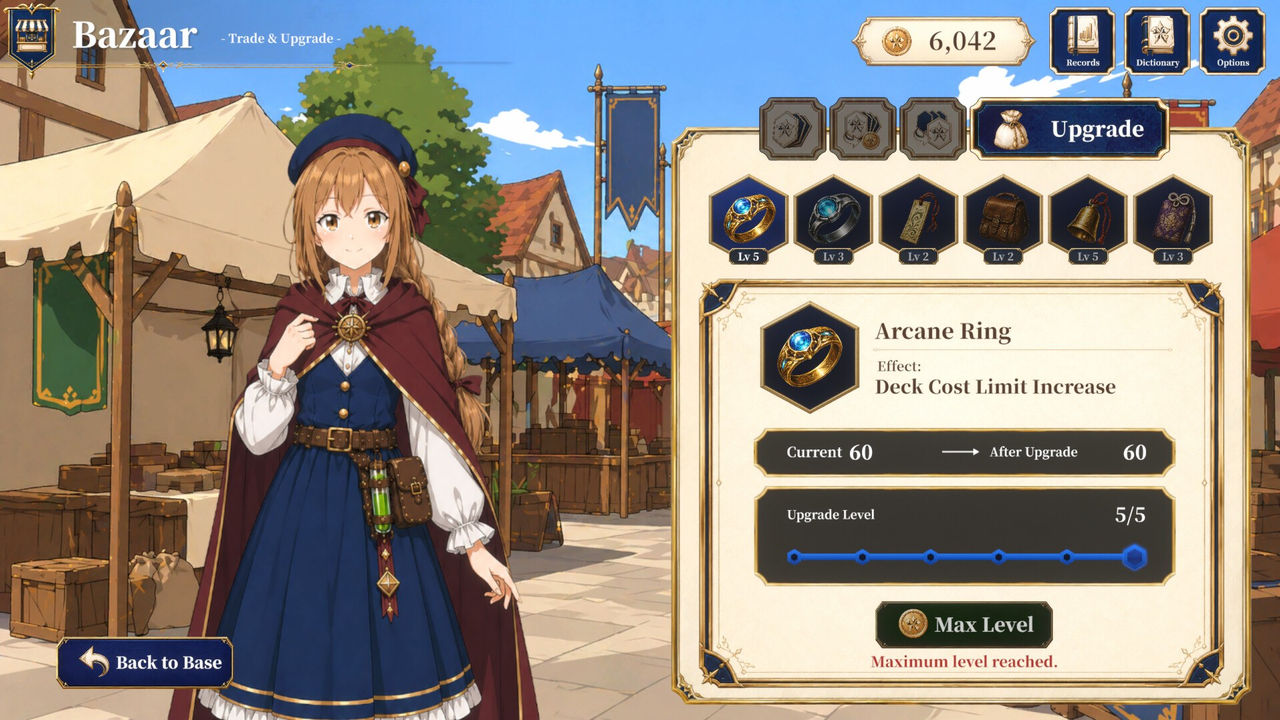
Pack contents, pack prices, the number of cards per pack, the rarity distribution inside a pack and any duplicate protection are all unpublished. The store page is equally silent on whether packs are limited per run or unlimited between runs. Because the game released on 7 October 2026 and the community hub is the place official and player documentation accumulates, that hub is worth checking as it fills in. The bazaar page covers the buying and selling alternative, and the cards page explains the six-value card a pack delivers.
FAQ
Are there card packs in Hex Reverse?
Yes, random packs are referenced by the achievement list, which includes a goal for obtaining an S-rank card from a random pack. That confirms packs exist, that they are random and that they can contain the top rarity. How packs are bought, what they cost and how many cards each one holds are not published on the store page, so those details are not documented yet.
What are the drop rates for S-rank cards in Hex Reverse?
Not documented yet. No drop rate, rarity percentage or pity system is published anywhere in the official material, and the store page does not describe the pack contents at all. Any specific S-rank percentage you see elsewhere is not supported by an official source, so treat it as unverified.
How are packs different from fusion?
They are the two documented routes to a high-rarity card. Packs are random, so the result is out of your hands, while fusion is the deliberate route in which you combine cards into a stronger one. The achievement list tracks an S-rank result from each, which is why the two are usually mentioned together when planning a collection.
Is there a Hex Reverse pack worth buying first?
That cannot be answered from the official material, because no pack names, prices or contents are published. Without a published pool or rate, comparing one pack with another would be guesswork. The safe approach is to read the pack screen in game, where the contents and any cost are shown, and to treat any outside tier list as unverified.
More in Mechanics
More mechanics pages in Hex Reverse.
- Hex Reverse Bazaar — Buying, Selling Cards and the Gold LoopGuideUpdated 2026-10-08
- Hex Reverse Cards — Six Values, Edge Flips and Deck GrowthGuideUpdated 2026-10-08
- Hex Reverse Controls — Keyboard, Mouse and Controller SupportGuideUpdated 2026-10-08
- Hex Reverse Features — Hex Battles, Deckbuilding and ProgressionGuideUpdated 2026-10-08
References
- Hex Reverse on Steam
- Hex Reverse Steam Community Hub
- Hex Reverse appdetails (Steam Store API, frozen 2026-10-08)
Facts on this page are compiled from the references above. Items marked "to confirm" are single-source and not yet verified.