
Echoes of Mystralia · Builds · Guide
Echoes Of Mystralia Builds — Two-Spell Setups, Memories and Pivots
Echoes of Mystralia builds explained: two spells with two jobs, Memory tier picks, Relics, Lotus nodes, and how to pivot without wrecking a run.
By the New Game Wiki team · Updated 2026-10-04
On this page (9)
- What a Build Means in Echoes of Mystralia
- Starter Builds and the Two-Spell Rule
- Memory Tiers, Relics and When to Pivot
- Demo vs Early Access Builds
- What counts as a build in Echoes of Mystralia?
- How many spells should a beginner run in Echoes of Mystralia?
- When should you pivot your build mid-run?
- What are good pivot targets in Echoes of Mystralia?
- How is the Early Access build pool different from the demo?
Echoes of Mystralia builds are less about picking a class and more about deciding what job each of your two spell slots is doing. The community builds hub frames it as the intersection of your Watcher's Heart canvases, the Memories you collect during a run, the Relics that modify Mazarim, your permanent Lotus nodes, and the route you take through the Ash Forest. This page pulls that framework together with the official spellcrafting description from Steam and the official site, then covers the two-spell rule, the pivot rules, and how the Early Access pool differs from the demo.
The structural facts here are official, but the specific build advice comes from a community hub written before launch, so single-source recommendations are marked to confirm.
What a Build Means in Echoes of Mystralia
In most action RPGs a build is a talent tree. In this game, the credited builds hub says a build is the intersection of several moving parts: the Watcher's Heart canvases where spells are assembled, the Memories collected during that specific run, the Relics that globally modify Mazarim, the Lotus permanent nodes you buy between runs, and the route you choose. Because Memories can be reordered and triggers chain, two players with the same Relics can play completely differently if their spell logic diverges.
That has a practical consequence the hub states directly: a lightning build is not a theme tag, it is a question of where a Memory such as Inner Storm sits on the canvas. The official store page supports the same idea, describing Memories you combine, reorder, and enhance so a spell takes shape in front of you, and the official site adds that the spellcrafting system is designed to let you continually refine your fighting tactics so every round is a chance to reinvent your style.
The four layers of a run, as the hub separates them:
- Canvas is the fast build, changed mid-run as Memories arrive.
- Memories are discovered during the run, so they are the variable layer.
- Relics confirm patterns you already play and modify Mazarim globally.
- Lotus is the slow build, bought at the temple between runs.
| Layer | Where it is changed | How fast it moves |
|---|---|---|
| Watcher's Heart canvas | In-run crafting screen | Fast, room to room |
| Memories | In-run pickups and shops | Fast, RNG dependent |
| Relics | Found while exploring | Medium, one per run |
| Lotus nodes | Azimuth Temple hub | Slow, permanent |
Starter Builds and the Two-Spell Rule
The hub's clearest starting rule is two spells, two jobs. Early runs typically operate two active spell slots, and the recommendation is to assign one spell to boss single-target duty, built around reliable hit triggers and sustained damage, and the other to clearing or safety, built around trails, spirals, or mobility. The hub explicitly warns against duplicating roles across both slots until later slot upgrades prove you can afford it.
The hub also names several build archetypes it documents for Early Access, including a fire vortex framework, a lightning trail framework, and an ice control framework, alongside hybrid spellcraft builds. It treats all of them as process documentation rather than a frozen meta, because Early Access launches with new regions and a much larger Memory pool that will move the rankings. That caution is echoed by the official store page, which sells the system as craft your playstyle rather than a fixed set of finished spells.
A beginner-safe sequence drawn from that guidance:
- Put your most reliable damage spell in the first slot and treat it as the boss answer.
- Put a trail, spiral, or mobility spell in the second slot for clearing and escapes.
- Grab Relics that amplify the trigger or trail you already use instead of rebuilding mid-run.
- Spend Lotus on problems that repeat across runs, not on a single bad room.
- Avoid copying a tier list row without checking where each Memory sits on the canvas.

Memory Tiers, Relics and When to Pivot
The builds hub keeps a Memory tier list marked provisional, and it warns that Early Access adds more than 100 Memories plus new modifiers such as Pressure Buildup and Empty Stomach, so the demo-informed rankings are expected to shift after patches. That is why the hub tells players to read its Triggers and Modifiers page before copying a tier row verbatim: the rank of a Memory depends on where it is placed, not just on its name.
Its pivot rule is deliberately narrow. Pivot when the canvas fails a measurable test, such as boss health phase timers, elite time-to-kill, or repeated one-shot margins. Do not pivot because a shiny rare Memory appeared, unless it completes a trigger you were missing, such as an on-hit proc, a second element for an element bonus, or a haste trail for mobility. The hub names three good pivot targets: Windy Day when telegraphs outpace your movement, Cruel Thorns when your primary spell connects but lacks damage, and Rolling Stone when spawn-heavy modifiers need a body.
| Signal | Pivot target named by the hub | What it fixes |
|---|---|---|
| Telegraphs outrun your movement | Windy Day | Mobility and reaction time |
| Main spell connects but under-damages | Cruel Thorns | Missing single-target damage |
| Spawn modifiers have no body | Rolling Stone | Spawn-based damage delivery |
Two habits keep a pivot from becoming a rebuild:
- Change one row at a time and retest against the same encounter.
- Keep the Relic that supports your best trigger rather than chasing a new theme.
Demo vs Early Access Builds
The hub draws a clear line between the free demo and the full Early Access release. The Ash Forest demo caps at four core spell forms, about 50 Memories, roughly 15 Relics, the Therakan fight, and the Luciame Watcher duel. Early Access keeps all of that and adds three regions, Guardians, more than 100 Memories, and the new modifiers already mentioned, which is why builds that trivialize demo arenas can stumble later.
The official store page confirms the run structure those builds sit in: each journey ends with a return to the Azimuth Temple, where Watchers develop their skills, change their combat approach, and carry permanent progress forward. That loop is what makes the slow build layer matter, because Lotus nodes persist while Memories do not. If you want the spell-by-spell starting point, the spells page ranks the individual spells, the map page explains the route symbols that decide which rooms you enter, and the gameplay page walks through the full run loop from area to boss.
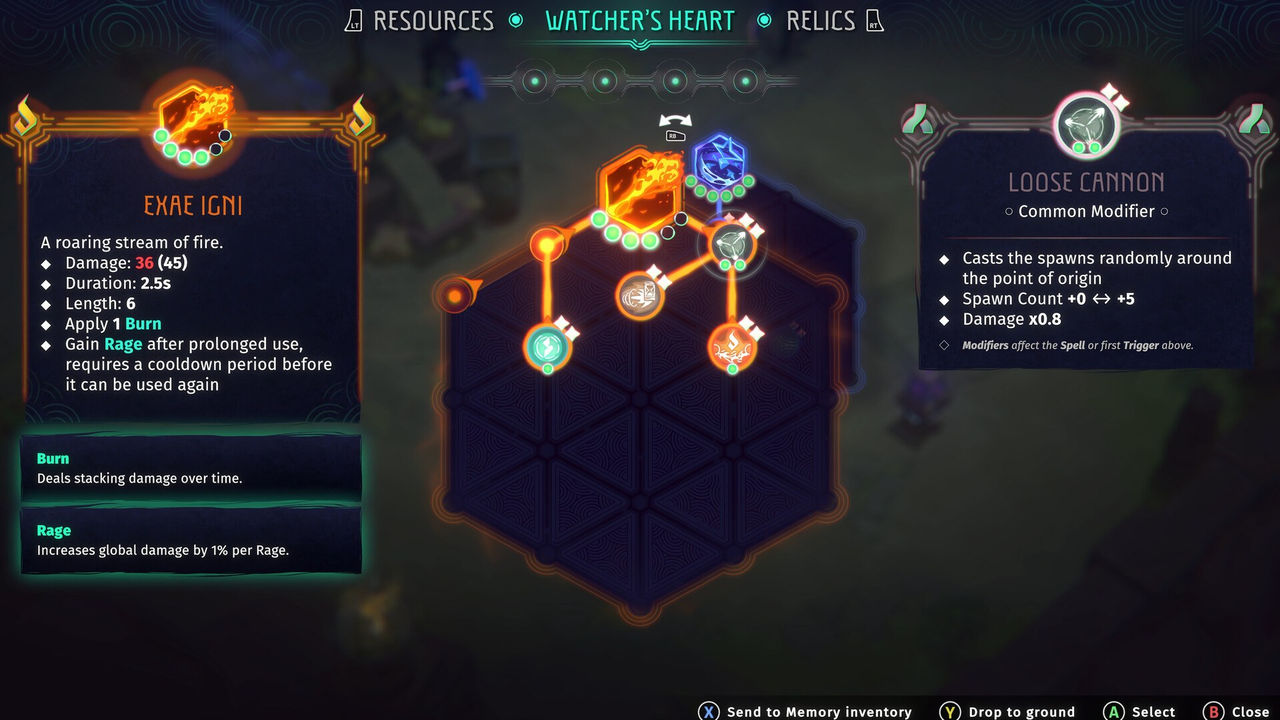
To summarize: treat the canvas as the fast build, Lotus as the slow build, keep two spells with two jobs, and pivot only on a measured failure rather than on a rare drop.
FAQ
What counts as a build in Echoes of Mystralia?
A build is not a talent tree. It is the combination of your Watcher's Heart canvases, the Memories you collected that run, the Relics that modify Mazarim, your permanent Lotus nodes, and the route you take through the Ash Forest or the Early Access regions.
How many spells should a beginner run in Echoes of Mystralia?
The community builds hub recommends using both Watcher's Heart slots with distinct roles: one spell for boss single-target damage and one for clearing or safety. Duplicating the same role across both slots is described as wasted coverage until later slot upgrades.
When should you pivot your build mid-run?
The builds hub says to pivot only when the canvas fails a measurable test, such as boss phase timers, elite time-to-kill, or repeated one-shot margins. Do not pivot just because a rare Memory appeared unless it completes a trigger you were missing.
What are good pivot targets in Echoes of Mystralia?
Named examples from the builds hub include adding Windy Day when enemy telegraphs outpace your movement, swapping to Cruel Thorns when your main spell connects but lacks damage, and inserting Rolling Stone when spawn-heavy modifiers need a body to work with.
How is the Early Access build pool different from the demo?
The demo caps at four core spell forms, about 50 Memories, roughly 15 Relics, the Therakan fight, and the Luciame Watcher duel. Early Access adds three regions, Guardians, more than 100 Memories, and new modifiers such as Pressure Buildup and Empty Stomach.
References
- Echoes of Mystralia Builds Hub | Echoes (Aug 2026)
- Echoes of Mystralia: Home
- Echoes of Mystralia on Steam
- I think we found our first TRULY broken build! | Echoes of Mystralia (YouTube)
Facts on this page are compiled from the references above. Items marked "to confirm" are single-source and not yet verified.