
Dawson Oaks Trailer Park · Gameplay · Guide
Dawson Oaks Trailer Park How to Play — Roles, Urges and the Tutorial
Dawson Oaks Trailer Park how to play: the tutorial chain, suspect roles and urges, sanity, the public store log, and how the Snitch and Supervisor vote works.
By the New Game Wiki team · Updated 2026-10-04
On this page (10)
- The Three Layers of a Dawson Oaks Match
- Character Creation and the Opening Tutorial
- Urges, Sanity, and the Public Store Log
- Meetings, the Snitch, and the Vote
- Lobby Settings and a First-Match Checklist
- How do you play Dawson Oaks Trailer Park?
- What are the suspect roles in Dawson Oaks Trailer Park?
- What happens if you ignore your urges?
- How do meetings and the Snitch vote work?
- Who calls the police in Dawson Oaks Trailer Park?
Dawson Oaks Trailer Park is a proximity voice chat social deduction game, and learning how to play it means learning three things at once: how to act out a criminal role without looking like a criminal, how to read the public clues the game leaks, and how to survive the meetings where the crew hunts for the Snitch. The Steam page frames the whole match as criminals committing secret crimes while a Supervisor hunts them and a hidden Snitch betrays them from within. This page walks through the tutorial, the role and urge systems, the public store log, and the vote, using the official Steam description and a full recorded community session as the source.
This guide is compiled from the official Steam store page and the credited community gameplay recordings; anything that rests on a single recorded session is marked to confirm.
The Three Layers of a Dawson Oaks Match
Every round splits the lobby into three layers that want different outcomes. Suspects are the criminal majority who must complete role urges to stay sane while pretending to be ordinary neighbours. The Supervisor is a single player who watches behaviour and calls the police once the evidence is strong enough. The Snitch looks like a suspect but works for the Supervisor, tracking everyone and secretly reporting what they see. Understanding who is playing which layer is the whole game, because the suspects spend the match hunting the Snitch while the Supervisor hunts the suspects.
| Layer | Who they are | Win condition |
|---|---|---|
| Suspects | Eleven unique criminal roles, described as the criminals who must commit secret crimes | Finish urges, avoid arrest, and vote out the Snitch |
| Supervisor | A single authority figure who watches everyone and calls the police | Get the real criminals arrested before they clean up the park |
| Snitch | A hidden betrayer who blends in as a suspect and reports to the Supervisor | Stay hidden, feed the Supervisor evidence, avoid being voted out |
The recorded session shows how quickly these layers blur in practice: within the first minute one player announced their role out loud by mistake, and the Snitch immediately had a target without doing any detective work. The practical lesson is that voice chat is the main attack surface, so what you say and when you say it matters more than any menu.
Character Creation and the Opening Tutorial
The tutorial is a guided chain that teaches movement, interaction, and the sanity economy before it lets the real deductions start. In the recorded session the player starts by building a character with a moustache, thin eyebrows, a buttoned shirt, glasses, and a body type, then picks a first and last name, and the game shows that tattoos are part of the same creation screen. A message from the Supervisor, Richard Dawson, tells you to meet at the community centre and leaves cash in your dresser. The dresser is the key tutorial idea: it is where all the items required for your role arrive, and it can also contain items meant for other roles, so an unlocked room with an open dresser can hand a visitor the information that reveals what you are.
The opening job is deliberately mundane. You buy milk from the store for five dollars, chug a carton, and the game uses that errand to teach two systems at once: purchases are visible to everyone through the transaction log, and ordinary legal actions are how a Snitch with a cover story looks innocent. Once the tutorial hands you a real objective, you observe a shady deal, listen to the conversation, and open your notebook with the number six key to compare what you saw against the suspect pages, which list that character's urges. Each suspect page doubles as a checklist, so the notebook is both a hint system and a record of what the crew can prove.
- Meet Richard Dawson at the community centre after taking the cash from your dresser.
- Lock your bedroom door before you leave; an open room can expose the items that reveal your role.
- Buy the tutorial item at the store and watch the transaction appear in the public trade log.
- Open the notebook with the six key to read each suspect page and their listed urges.
- Use the tab overlay to review every item you received for this match.
Urges, Sanity, and the Public Store Log
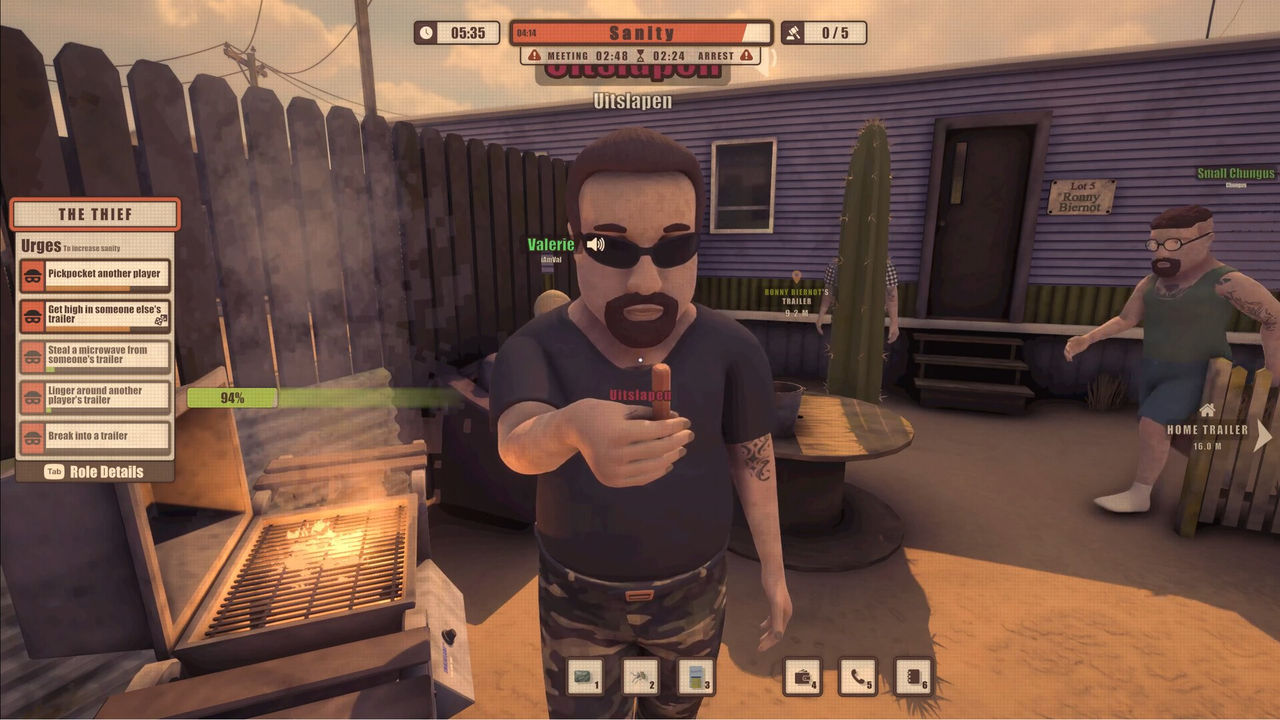
Urges are role-specific criminal actions, and refusing them is a slow loss. The Steam description states that the longer you wait, the more unstable you become and the easier it is for others to expose you, which turns sanity into a timer that pushes every suspect toward committing crimes in the open. The recorded session shows concrete urge lists: the Junkie is prompted to get high in their own trailer, buy weed, get high in someone else's trailer, and spray air freshener, while the gambling-addict cover character is prompted to win money at the slot machine, borrow money from another player, smoke a cigarette, and drink an energy drink. Because many of those actions happen at shared locations, the store and the bar become the places where behaviour is easiest to compare between players.
The store log is the game's most reliable public evidence. Every purchase from the store is recorded and the trade log is visible to everyone, so buying the item that matches a known urge is effectively a confession. The recorded session used exactly that logic when the Snitch watched a player buy weed from another suspect and then checked the notebook to confirm that buying weed was a Junkie urge. The Snitch has the opposite relationship with crime: the same recording notes that the Snitch carries a sanity drainer that makes crime cost sanity instead of relieving it, and that the Snitch gets an exclusive urge the other roles do not share, which is a strong reason to fake enthusiasm carefully rather than sit quietly.
| Signal | Where you see it | What it usually means |
|---|---|---|
| Store purchase | Public transaction and trade log | The buyer may match a documented urge for a criminal role |
| Slot machine and bar activity | Shared bar area | Gambler-type urges are checked here in front of witnesses |
| Repeated legal-only behaviour | Anywhere in the park | A common Snitch cover, flagged in the recorded session as suspicious when it is the only thing someone does |
| Room and dresser access | Inside another player's trailer | Witnessing role items is direct proof, which is why locking doors matters |
Meetings, the Snitch, and the Vote
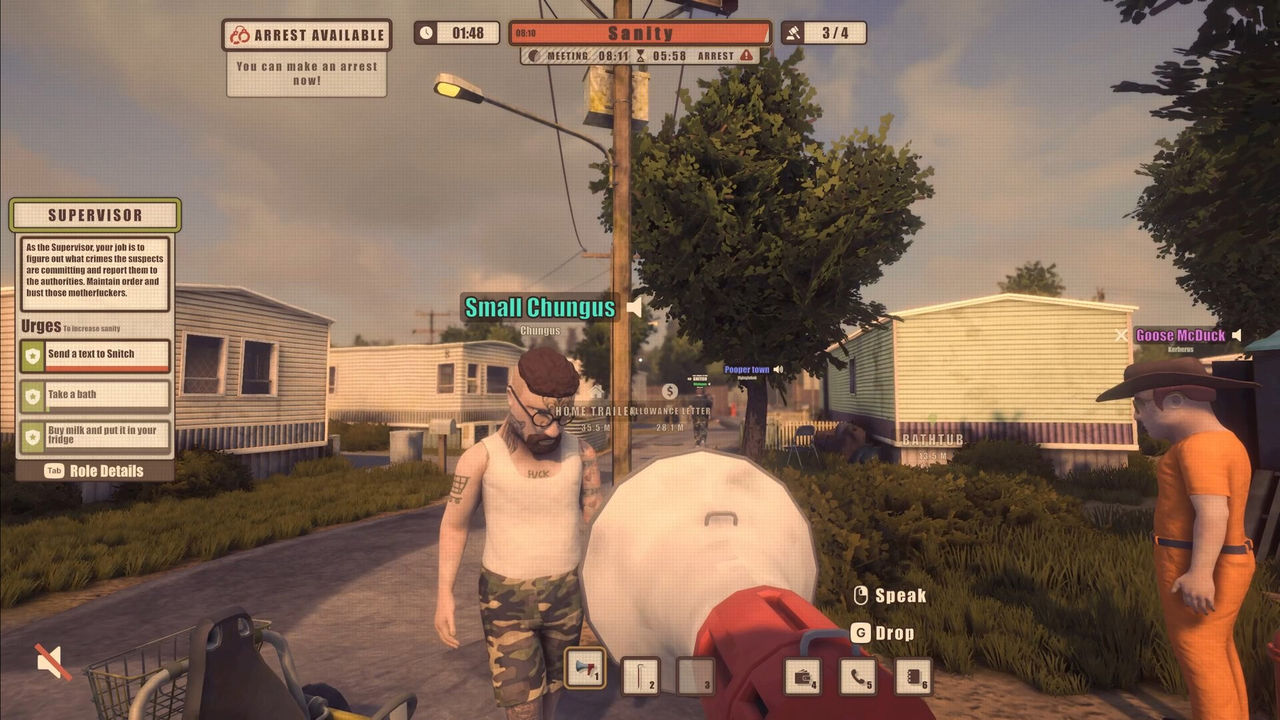
Meetings are the pressure valve. A suspect can call one at any moment with the air horn, and the Steam page describes the ritual precisely: everyone gathers, pretends to be friendly, and votes on who they think the Snitch is. Get it wrong and the real Snitch stays hidden; get it right and the suspects take control. That last clause is the stakes of the whole system, because control of the park passes to whoever wins the room, not to whoever has the most information. In the recorded session a meeting revolved around a crowbar sighting and a disputed photo, and the crew split over whether witnessing a tool was the same as witnessing a crime, which is the kind of ambiguity the Snitch is designed to exploit.
Because the Snitch votes from inside the suspect group, the safest behaviour for a suspect is to build a story that survives cross-checking. The recorded session is a case study in stories failing: one player claimed to have seen a crime the others never witnessed, another was exposed by the items in his own room, and a third was caught by the Supervisor on the phone with photographic evidence. The Supervisor, meanwhile, only has power while they have information, so the Snitch's phone calls and photos are what turn suspicion into an arrest. If the Snitch is voted out early, the Supervisor is left with guesses, which is why protecting the Snitch's cover is its own win condition.
- Call a meeting when you have a concrete sighting rather than a feeling, because vague accusations are what get suspects voted out.
- Cross-check a claim against the store log and the notebook before you back it, since the game rewards provable behaviour.
- Expect the Snitch to mirror the group, so treat a player who only ever does legal actions as a lead rather than a clear.
- Keep your own urge history consistent with your cover story, because your purchases are public even when your role is not.
Lobby Settings and a First-Match Checklist
The lobby is more configurable than the store page implies, and the recorded session walked through the options that change difficulty. The host can set the number of Snitches so that a small crew is not overwhelmed by a single hidden role, raise the sanity gain multiplier so that completing tasks is more forgiving, choose a beginner-friendly game mode, and even set roommates, which changes who can walk into whose living space. Patch 1.0.4 added three lobby types with their own conduct rules, so the social experience is a setting rather than a fixed default.
| Lobby type | Tone | Rule of thumb |
|---|---|---|
| Respectful | Clean and moderated chat | Swearing, insults, and harassment are not allowed and can lead to a ban |
| Rowdy | Trash talk allowed | Swearing and trash talk are fine, but slurs, hate speech, and harassment are not |
| Uncensored | Almost anything goes | Strong language and edgy roleplay are expected, while real threats remain banned |
If you are new, treat your first match as a tutorial for the social layer rather than a test of deduction. Lock your room, buy nothing that obviously matches a criminal urge until you understand your cover, keep your notebook open during your first couple of meetings, and lean on the lobby settings the host can adjust. The recorded session lands on a useful framing: the suspects are not just hunting a name, they are reading behaviour, and the Snitch is the only player whose job is to be read poorly.
Once you understand the loop, the deep dives are easier to place: the roles page breaks down every suspect role and its urges in one place, the multiplayer page covers party size and how matches are hosted, and the gameplay page explains how a typical round flows from first crime to final vote.
FAQ
How do you play Dawson Oaks Trailer Park?
It is a proximity voice chat social deduction game. Most players are criminals with secret role urges, one player is the Supervisor who wants them arrested, and a hidden Snitch feeds the Supervisor information. You act out your urges, watch the public store log and trade log for clues, and vote at meetings on who the Snitch is.
What are the suspect roles in Dawson Oaks Trailer Park?
The Steam page lists eleven unique suspect roles: Drug Dealer, Junkie, Moonshine Cook, Creep, Scrapper, Pyromaniac, Gambler, Thief, Drunk, Prankster, and Hobo. The Supervisor and the Snitch sit outside that list as the two hidden authorities.
What happens if you ignore your urges?
The longer you wait to commit your role-specific urge, the more unstable you become, and instability makes it easier for the other players to expose you. Committing crimes keeps a suspect sane, while the Snitch carries a sanity drainer that punishes crime, which is part of why the Snitch has to fake enthusiasm for the crew's behavior.
How do meetings and the Snitch vote work?
At any moment a suspect can call a meeting with the air horn. Everyone gathers, pretends to be friendly, and votes on who they think the Snitch is. Get it wrong and the real Snitch stays hidden; get it right and the suspects take control. If the Snitch is voted out, the Supervisor's side loses its inside source.
Who calls the police in Dawson Oaks Trailer Park?
The Supervisor does, once they have enough information. The police is another player, not an AI, so the Supervisor needs evidence to justify a call, and the Snitch exists to supply that evidence through the phone and photo systems.
More in Gameplay
More gameplay pages in Dawson Oaks Trailer Park.
- Dawson Oaks Trailer Park How Many Players — Party Size and Co-opGuideUpdated 2026-10-04
- Dawson Oaks Trailer Park Game Roles — Suspects, Supervisor and SnitchGuideUpdated 2026-10-04
References
- Dawson Oaks Trailer Park on Steam
- Dawson Oaks Trailer Park — Steam Community Hub
- Striped Panda Studios — Official Site
- Teo & Friends play Dawson Oaks Trailer Park (YouTube)
Facts on this page are compiled from the references above. Items marked "to confirm" are single-source and not yet verified.