
Dawson Oaks Trailer Park · Game Guides · Guide
Dawson Oaks Trailer Park Gameplay — The Social Deduction Loop Explained
Dawson Oaks Trailer Park gameplay explained: proximity voice chat, secret urges, public store logs, meeting votes, and the Snitch hiding in a criminal crew.
By the New Game Wiki team · Updated 2026-10-04
On this page (10)
- What Makes the Gameplay Different
- The Shape of a Round
- The Systems Behind the Drama
- Match Settings That Change the Game
- Launch Patches and Current State
- What kind of game is Dawson Oaks Trailer Park?
- How does a Dawson Oaks Trailer Park round flow?
- Is Dawson Oaks Trailer Park online or local?
- What are the Dawson Oaks Trailer Park system requirements?
- Has Dawson Oaks Trailer Park been updated since launch?
Dawson Oaks Trailer Park is a proximity voice chat social deduction game, and its gameplay is less about shooting and more about being watched. The Steam summary sets the tone: criminals must commit secret crimes while a Supervisor hunts them, and a hidden Snitch betrays them from within. Around that premise the game builds a small open park where every purchase is logged, every conversation is nearby, and every meeting ends with a vote. This page explains the loop, the tag profile Steam and SteamDB apply to the game, the settings that shape a match, and the patches that have changed it since launch.
This page is compiled from the official Steam store page, the Steam Community hub including its patch notes, and credited community gameplay recordings; figures that rest on a single source are marked to confirm.
What Makes the Gameplay Different
Most social deduction games abstract the map away, but Dawson Oaks Trailer Park gives you a physical park and lets your voice carry as far as the room allows. That proximity rule changes everything: you cannot privately coordinate with a distant teammate, you cannot whisper a plan across the park, and leaving a conversation is itself a visible act. The Steam store description reinforces the same idea by making the Supervisor's power informational rather than physical, and by describing the Snitch as someone who blends in and tracks behaviour instead of fighting. The result is a game where the interesting decisions are social positioning, not mechanical skill.
The tag profile confirms the intent. SteamDB lists the game under Casual, Simulation, RPG, Strategy, and party-based RPG tags, with social deduction, comedy, PvP, co-op, and team-based tags layered on top. The Steam category list is broader still, offering multi-player, PvP, online PvP, LAN PvP, co-op, online co-op, LAN co-op, Steam Achievements, custom volume controls, stereo sound, family sharing, and accessibility flags for playable-at-your-own-pace and playable-without-timed-input. In practice the accessibility flags matter, because a game built on conversation also needs options for players who do not want timed inputs.
| Steam category | What it means for a match |
|---|---|
| Multi-player, online PvP, LAN PvP | Every match is social, with both online and local-network hosting |
| Co-op, online co-op, LAN co-op | The criminal majority is a cooperating team that also distrusts itself |
| Playable at your own pace | There is no mandated clock pushing every role at the same speed |
| Playable without timed input | Conversation and reading can be done without a reaction-time penalty |
The Shape of a Round
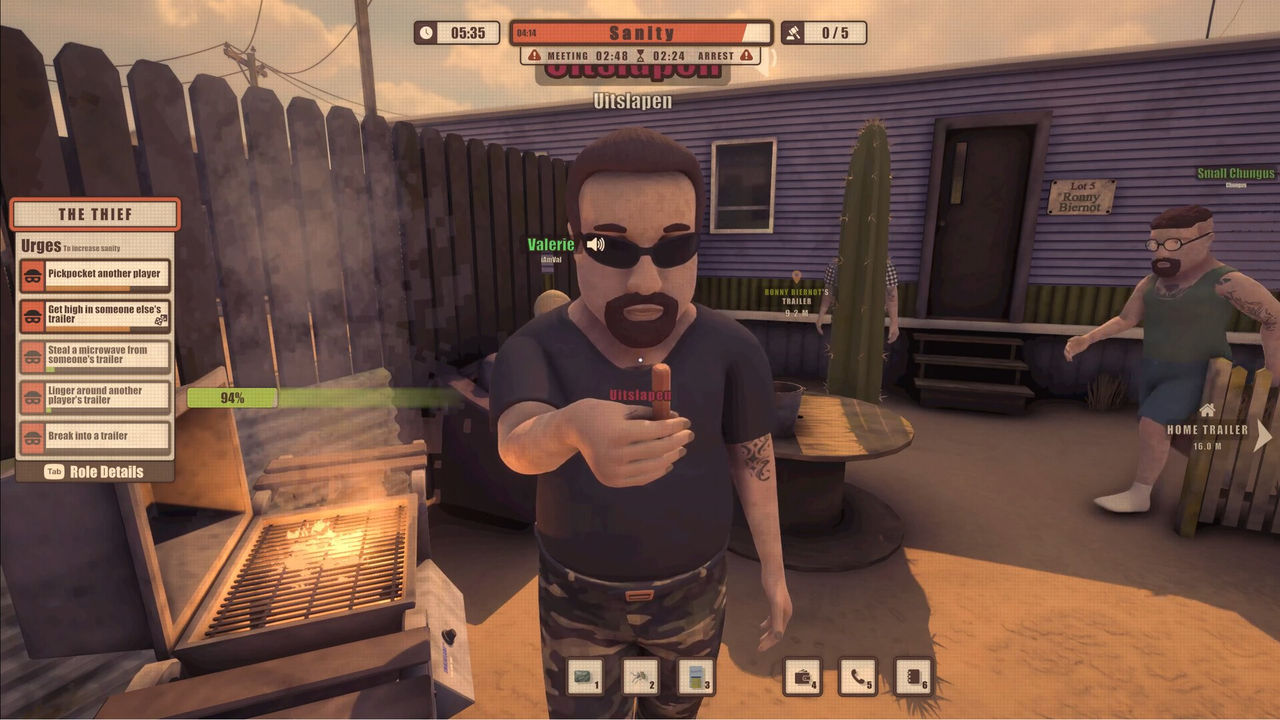
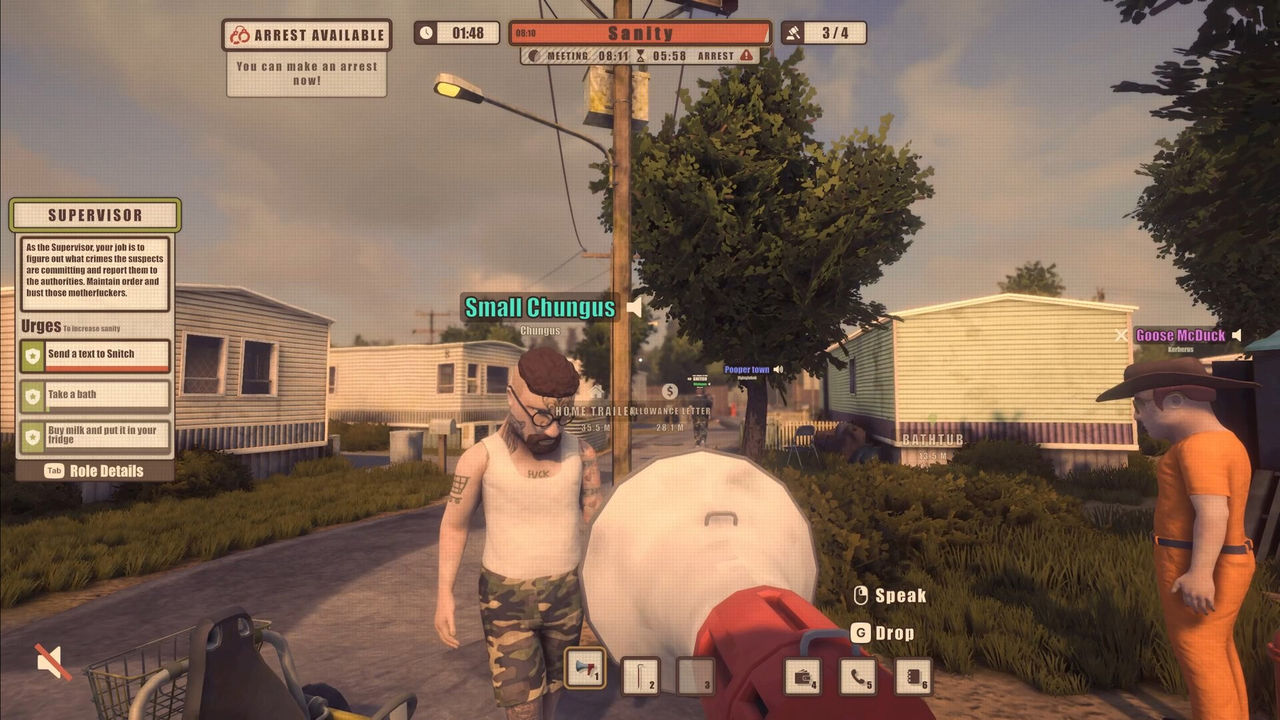
A round moves through recognisable phases rather than a fixed sequence, because players decide when to trigger the loud moments. The quiet phase is where most information is created: characters shop, drink, gamble, and visit each other, and every one of those actions leaves a trace for someone to notice. The active phase is where suspicions harden, usually because a crime was witnessed or a public purchase matched a known urge. The meeting phase is where the crew converts that information into a vote, and the aftermath is where the arrested or voted-out player leaves and the Supervisor's evidence pipeline either survives or dries up. The recorded session runs this exact arc from a tutorial errand to a contested meeting about a crowbar.
| Phase | What players do | What the game records |
|---|---|---|
| Quiet | Shop, drink at the bar, visit trailers, complete mundane tutorial errands | Store and trade log entries visible to everyone |
| Active | Commit role urges, witness crimes, take photos and phone calls | Sightings, items in rooms, and behaviour witnesses describe |
| Meeting | Gather, argue, and vote on who the Snitch is | The vote result and who the group removed |
| Aftermath | Remove a player, reset positions, continue the park | The Supervisor's remaining information supply |
The Systems Behind the Drama
Three systems do most of the work in a Dawson Oaks Trailer Park match. The first is proximity voice chat, which turns every conversation into a location-bound event and makes eavesdropping a real tactic. The second is the public economy, because the store logs every purchase and the trade log is visible to all, so an action as small as buying milk for a tutorial task is also a public statement. The third is the notebook, which lists each suspect's urges and turns a player's behaviour into something the crew can compare and debate. Together these three systems mean the game is legible: almost everything a suspect needs to prove is already recorded somewhere.
The recorded session is a good demonstration of how these systems interact. A player bought weed from another suspect, the Snitch watched the handover, and the notebook confirmed that buying weed sat on the Junkie's urge list. Later, a meeting split over whether witnessing a crowbar counted as witnessing a crime, and the argument mattered because the police and the vote both depend on what the group can agree actually happened. The Supervisor also leaned on photos and phone messages, which is the intended way to convert private sightings into public consequences.
- Use the store and trade log as your primary evidence source, because it is the one record everyone shares.
- Read the notebook before accusing, since matching a purchase to a listed urge is stronger than matching it to a personality.
- Treat photos and phone reports as the Supervisor's currency, and expect them to shape the next meeting.
- Watch where conversations happen, because proximity voice chat makes location a form of evidence.
Match Settings That Change the Game
The lobby settings are part of the gameplay rather than an afterthought, because they decide how much pressure each side carries. The host can adjust the number of Snitches, which softens or sharpens the hidden-role pressure on a small crew, raise the sanity gain multiplier so that completing tasks offsets the urge timer, and pick a beginner-friendly game mode for newer lobbies. Roommate settings are the quietest but most interesting option, because sharing a living space changes who can walk into whose room and therefore how easily role items leak. Patch 1.0.4 then added three lobby types with different conduct rules, giving hosts a social filter on top of the mechanical settings.
| Setting | Documented effect |
|---|---|
| Snitch count | Raises or lowers the number of hidden betrayers in the lobby |
| Sanity gain multiplier | Makes completing tasks more or less rewarding against the sanity drain |
| Game mode | A beginner-friendly option exists for newer players |
| Roommates | Changes which players share living space and can enter each other's rooms |
| Lobby type | Respectful, Rowdy, and Uncensored set the expected chat conduct |
Launch Patches and Current State
The game shipped as a full release rather than an Early Access build, and the first month of patches has been small and functional. Patch 1.0.3 on September 19, 2026 added Brazilian Portuguese localisation and fixed several things, including the Supervisor being unable to call the police and vote and result screens not appearing for some clients. Patch 1.0.4 on September 21, 2026 introduced the three lobby types and capped tear tattoos at five after they were repeatedly misused as a griefing tool. Patch 1.0.5 on September 26, 2026 was a small update to fix minor bugs and address exploits, which tells you the studio is prioritising live stability over feature drops.
- 1.0.3, September 19, 2026: localisation and the Supervisor police-call fix, plus vote screen fixes.
- 1.0.4, September 21, 2026: Respectful, Rowdy, and Uncensored lobbies, and a five-tattoo cap.
- 1.0.5, September 26, 2026: minor bug and exploit fixes.
- The Steam store page lists two official videos, a Dawson Oaks Trailer Park Trailer and a Gameplay Trailer.
If the loop sounds appealing, the next steps are practical: the how-to-play page covers the tutorial and the first-match checklist, the roles page breaks down every suspect and the two hidden roles, and the multiplayer page explains party size and how to host a lobby.
FAQ
What kind of game is Dawson Oaks Trailer Park?
It is a proximity voice chat social deduction game built around a full trailer park. Steam lists it under Casual, RPG, Simulation, and Strategy with social deduction and party-based RPG tags, and the store summary describes criminals committing secret crimes while a Supervisor and a hidden Snitch work against them.
How does a Dawson Oaks Trailer Park round flow?
A round moves through ordinary park behaviour, secret urge actions, public purchases, an arrest or two, and then a meeting where everyone votes on who the Snitch is. The meeting outcome decides whether the suspects take control or the real Snitch stays hidden for another cycle.
Is Dawson Oaks Trailer Park online or local?
It supports online and LAN play. The Steam category list includes multi-player, PvP, online PvP, LAN PvP, co-op, online co-op, and LAN co-op, and the recorded sessions are hosted lobbies with friends rather than random matchmaking.
What are the Dawson Oaks Trailer Park system requirements?
Steam lists Windows 10, an Intel i5-6400, 4 GB of RAM, an Nvidia GTX 960, DirectX 11, a broadband connection, and 5 GB of storage as the minimum. The recommended tier moves to Windows 11 and 8 GB of RAM, and SteamDB records the game as Steam Deck Playable.
Has Dawson Oaks Trailer Park been updated since launch?
Yes. Patch 1.0.3 on September 19, 2026 added Brazilian Portuguese localisation and fixed the Supervisor's police call, patch 1.0.4 on September 21 introduced the Respectful, Rowdy, and Uncensored lobby types, and patch 1.0.5 on September 26 was a small bug and exploit fix.
References
- Dawson Oaks Trailer Park on Steam
- Dawson Oaks Trailer Park — Steam Community Hub
- Striped Panda Studios — Official Site
- Dawson Oaks Trailer Park (Kotaku game page)
Facts on this page are compiled from the references above. Items marked "to confirm" are single-source and not yet verified.