
Kernel Hearts · Game Guides · Guide
Kernel Hearts Guide — First Runs, Chips and Co-op
A Kernel Hearts guide to your first expeditions: the M.A.H.O.U Unit, chip loadouts on MAHOU.OS, co-op setup, the Sin Meter and how to leave a run.
By the New Game Wiki team · Updated 2026-10-04
On this page (10)
- The Four Systems the Game Introduces First
- What a Run Looks Like Step by Step
- Chips, MAHOU.OS and What Persists
- Co-op Setup and the Sin Meter
- Leaving a Run and What Carries Over
- What is Kernel Hearts?
- When was Kernel Hearts released and for how much?
- Does Kernel Hearts have co-op?
- Is Kernel Hearts a roguelike or a roguelite?
- Does Kernel Hearts have a free demo?
Kernel Hearts is a multiplayer co-op roguelike action RPG from Ephemera Games, published by Whitethorn Games on September 17, 2026, and this Kernel Hearts guide covers what your first few runs actually demand. You play one of four magical girls in the M.A.H.O.U Unit, climbing the Tower of Babel, eliminating the angelic creatures in your path and eventually dethroning God to save a world drowning in ashes. The official store page describes support for up to four players, each floor ending in a boss fight against that domain guardian, and prices the game at $19.99.
The Four Systems the Game Introduces First
The official store page lists four pillars, and all four appear within your early runs.
| System | What the official description says | Why it matters early |
|---|---|---|
| Attacks, spells and movement | Mix and match them with unique powers during each run to build combos | Your moment-to-moment damage depends on the combination you assemble |
| Chip customisation | Unlock and equip up to 256KB of chips on your Unit MAHOU.OS after each expedition | This is the metaprogression layer, not in-run gear |
| Transformation | Harness the tower to dispel the Heavenly Curse, hit nearby foes and reach your true form briefly | A burst button and a curse answer in one |
| Bonds | Interact with the tower inhabitants and give gifts to deepen bonds | A second progression track outside combat |
The store page also notes that after each expedition you return to the last memory backup in a laboratory on the outskirts of humanity last holdout, which is where you spend run rewards. That loop, not a single long campaign, is the spine of the game.

What a Run Looks Like Step by Step
Review coverage fills in the moment-to-moment loop that the store page only summarises. RPG Fan describes runs starting in the grassy meadows of an area it calls Folktale Fields, a large arena of rolling hills with semi-randomly placed structures and encounters. Because the whole floor is one open arena rather than a series of locked rooms, you choose which fights to take and in what order.
A practical first-run sequence looks like this:
- Pick a unit and start the expedition, then explore the arena instead of rushing the exit.
- Kill angels to collect pink Stray Souls, the currency you spend to level up at Moon Shrines placed around the map.
- Collect blue Lost Wishes to open coffins that grant abilities and passives.
- Watch the Sin Meter, the escalating run timer that raises enemy levels and adds catastrophes.
- Bank your upgrades and leave when the warning angel appears, rather than pushing for one more chest.
RPG Fan reports that the Sin Meter climbs quickly on Normal difficulty and that pushing greedily for one more coffin or one more relic is what ended its early runs. Treat the meter as the run budget.
Chips, MAHOU.OS and What Persists
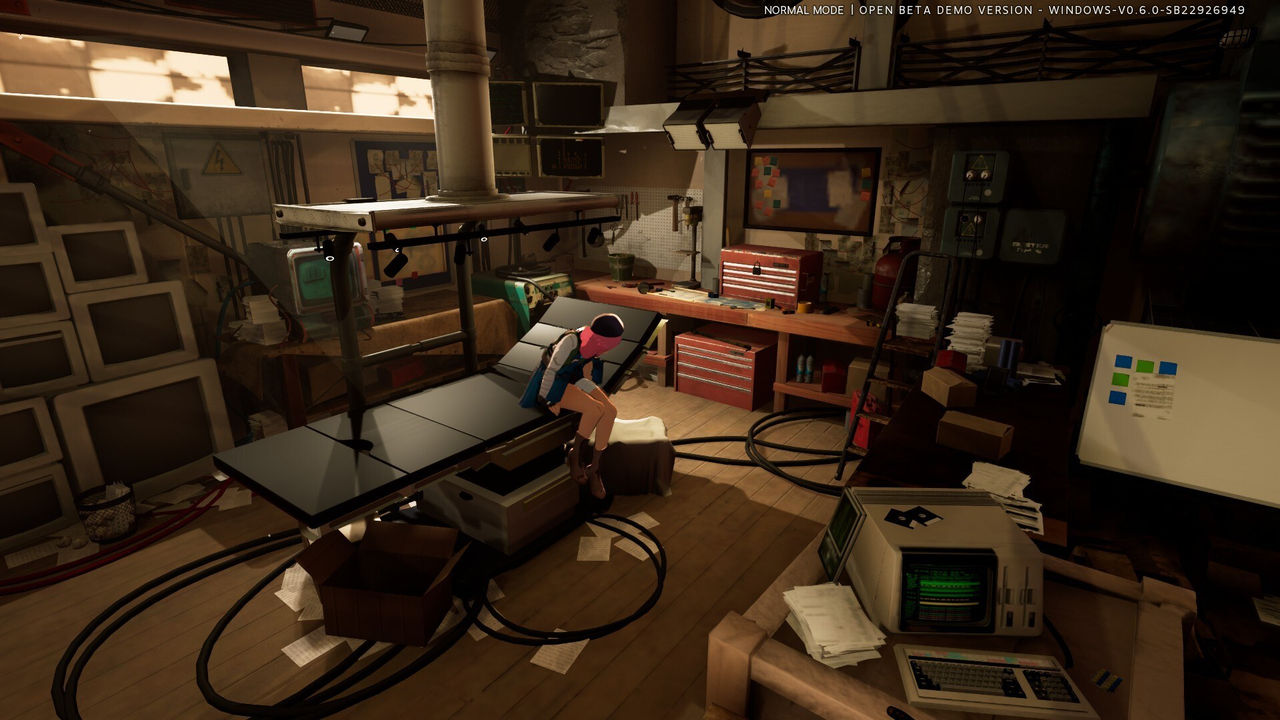
The chip system is the clearest source-backed progression mechanic. The official store text says you spend the rewards from each run to unlock and equip up to 256KB of chips onto your Unit MAHOU.OS, and to customise them as you see fit. That wording matters: the cap is described in kilobytes, so loadout building is about budgeting a fixed space rather than stacking unlimited upgrades.
It helps to separate the two progression layers, because only one of them survives a death.
| Layer | Where it lives | Survives between runs |
|---|---|---|
| In-run character levels | Bought at Moon Shrines with Stray Souls inside the arena | No, it is rebuilt each expedition |
| In-run ability unlocks | Granted by coffins opened with Lost Wishes | No, it is rebuilt each expedition |
| Chips on MAHOU.OS | Equipped in the lab after an expedition | Yes, this is the documented metaprogression |
Two things are worth setting expectations on. First, RPG Fan argues that the metaprogression buffs from unlockable chips are practically negligible and difficult to feel against exponentially scaling enemies, so do not assume chips alone will carry a late floor. Second, the exact list of chip types and their numeric effects is not published on the store page; treat third-party chip tier lists as to confirm until the developers document them.
Co-op Setup and the Sin Meter
Co-op is a first-class feature rather than an afterthought. The Steam listing carries single-player, multi-player, co-op, online co-op and cross-platform multiplayer categories, plus Steam Cloud and partial controller support, and the Epic Games Store listing notes that an Epic ID login is required there. Because floors are open arenas, adding players does not change the layout logic, only the total damage and the chaos. The official description explicitly frames the pitch as punching biblical monsters with up to four friends.
The Sin Meter is the shared pressure clock that makes co-op pacing matter. RPG Fan describes it scaling enemy levels and introducing catastrophes such as comets and vision-reducing eclipses, and reports that at 90 per cent a biblically accurate angel appears in the sky to tell you to move to the next floor via a randomly placed cosmic elevator, with a bellhop named Daiki. At 100 per cent, that same source says the angel either rains fire or drains your life bar. Coordinating when to bank and climb is therefore a team decision, not a solo one.
Leaving a Run and What Carries Over
Leaving is a mechanic, not a failure state. The official text says that after each expedition you return to your last memory backup, so the fiction frames death as a restore point. In practice, the run rewards you banked are what you spend on chips for the next attempt.
- Do not treat a run as winnable if the Sin Meter is already past the warning stage; bank and reset.
- Spend rewards between runs on chip capacity rather than hoarding them.
- Re-check whether specific upgrades persist across deaths, because the store page does not state which rewards survive and which are consumed.
That last point is a genuine gap rather than a hidden feature: the official listing does not itemise what carries over between runs, so any claim about permanent versus temporary rewards should be marked to confirm until it is documented.
FAQ
What is Kernel Hearts?
Kernel Hearts is a multiplayer co-op roguelike action RPG from Ephemera Games, published by Whitethorn Games. You play one of four magical girls in the M.A.H.O.U Unit climbing the Tower of Babel to defeat angels and dethrone God.
When was Kernel Hearts released and for how much?
It launched on September 17, 2026 for $19.99 on Steam and the Epic Games Store, with PlayStation 5, Xbox Series X and S and Nintendo Switch 2 versions listed by the publisher.
Does Kernel Hearts have co-op?
Yes. The Steam store page lists single-player, multi-player, co-op, online co-op and cross-platform multiplayer, and the official description says you can punch biblical monsters with up to four friends.
Is Kernel Hearts a roguelike or a roguelite?
The official store text calls it a unique blend of action RPG and roguelike elements. Runs are repeatable and the metaprogression lives in a chip system rather than permanent character levels.
Does Kernel Hearts have a free demo?
Yes. A free Kernel Hearts demo is published as its own listing on the Epic Games Store, so you can try the loop before paying for the full game.
More in Game Guides
More game guides pages in Kernel Hearts.
- Kernel Hearts Tips — Chips, Sin Meter and Early MistakesGuideUpdated 2026-10-04
- Kernel Hearts Walkthrough — Run Structure and Floor OrderGuideUpdated 2026-10-04
References
- Kernel Hearts on Steam
- Kernel Hearts official site
- Kernel Hearts at Whitethorn Games
- Kernel Hearts Review (RPG Fan)
- Kernel Hearts Review (No Small Games)
Facts on this page are compiled from the references above. Items marked "to confirm" are single-source and not yet verified.